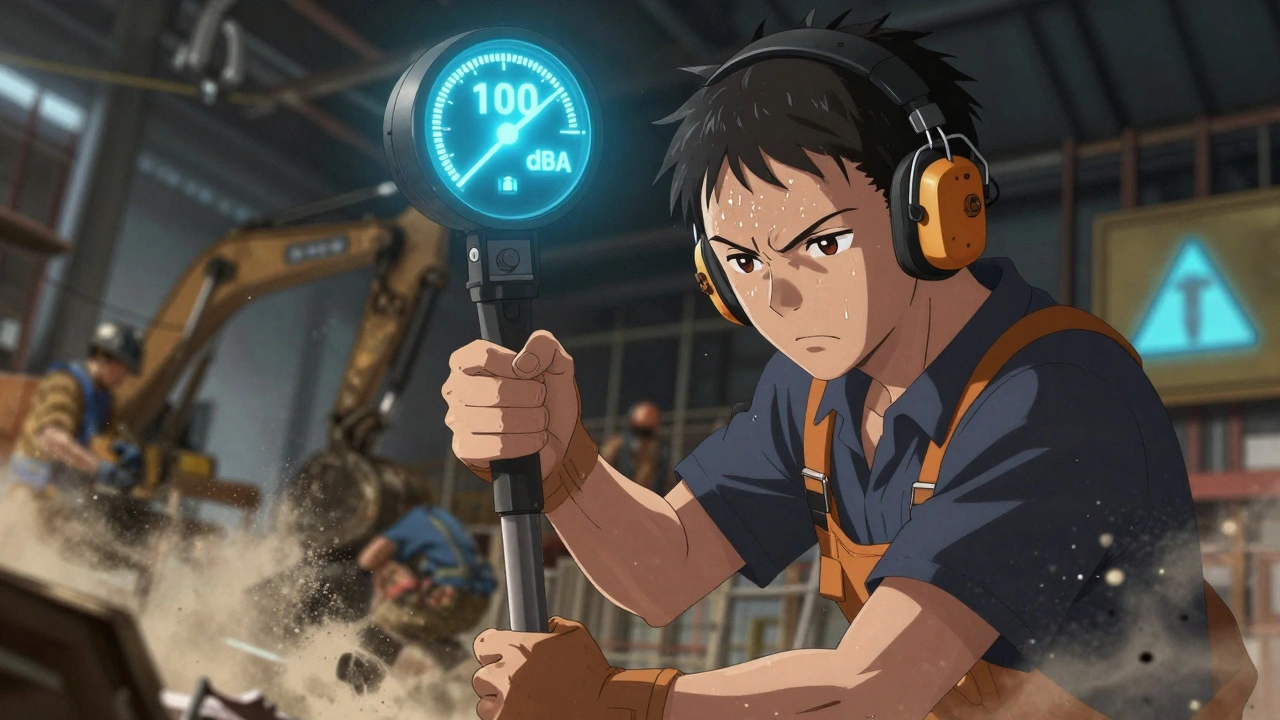
Every year, millions of people lose their hearing-not from aging, not from illness, but from something completely preventable: too much noise. Whether you're working on a construction site, operating a jackhammer, or standing in front of speakers at a concert, the sound around you can quietly damage your ears. And once that damage is done, it’s permanent. The good news? We know exactly how much noise is safe. The problem is, most people don’t know the rules-or they ignore them.
What Counts as Dangerous Noise?
Noise isn’t just loud. It’s about how long you’re exposed and how intense it is. The science is clear: continuous exposure to 85 decibels (dBA) or higher over an 8-hour period can cause hearing loss. That’s about the level of a lawnmower, a busy city street, or a blender running. At 90 dBA-like a motorcycle or a power tool-you’re already in danger zone. And at 100 dBA, which is what you might hear at a rock concert or near a chainsaw, your safe exposure time drops to just 15 minutes.Here’s the math: for every 3-decibel increase above 85 dBA, your safe exposure time cuts in half. So 88 dBA? Only 4 hours. 91 dBA? Just 2 hours. 100 dBA? 15 minutes. This is the standard used by NIOSH, the National Institute for Occupational Safety and Health, and it’s based on decades of research. OSHA, the federal agency that enforces workplace safety, uses a looser standard-90 dBA as the limit. That means under OSHA rules, you could legally be exposed to noise levels that NIOSH says are unsafe. And that gap matters. NIOSH estimates that following their 85 dBA limit would reduce the risk of hearing loss among workers from 25% down to under 8%.
Why the Rules Are Different at Work vs. at a Concert
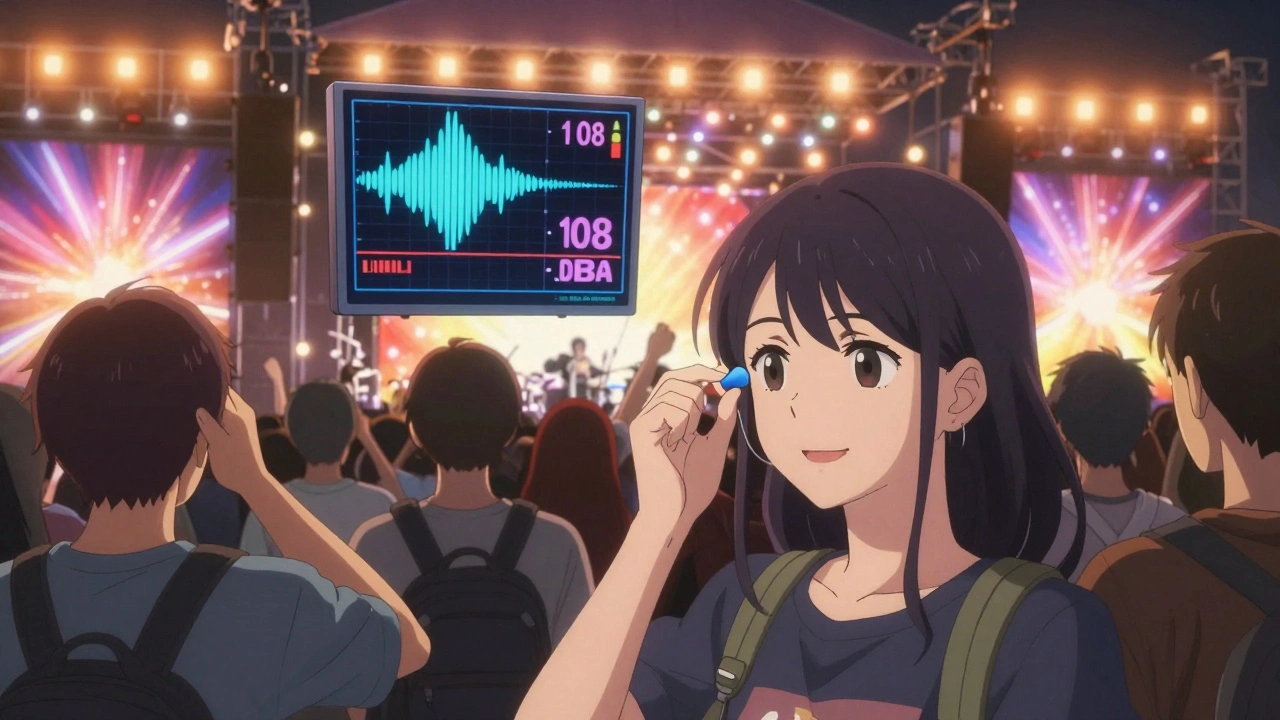
At work, employers are legally required to protect you. If noise hits 85 dBA, they must offer hearing protection, train you on how to use it, and set up a hearing conservation program. At 90 dBA, they have to try to reduce the noise itself-by installing quieter machines, enclosing noisy equipment, or rotating workers out of loud areas. But concerts? Nothing’s required. No law says a music venue must limit volume, offer earplugs, or warn you how loud it is.That’s changing. The World Health Organization recommends limiting personal audio device use to 40 hours a week at 80 dBA. Many music festivals now hand out free earplugs. Some venues, like Lifehouse Festival, report that 75% of attendees take them. Others have installed “quiet zones”-areas where the sound drops to 70-75 dBA, so you can rest your ears. Real-time sound level displays are popping up too, showing you the decibel reading right above the stage. That’s progress. But it’s still voluntary. Most clubs and concerts still blast 100-110 dBA without warning.
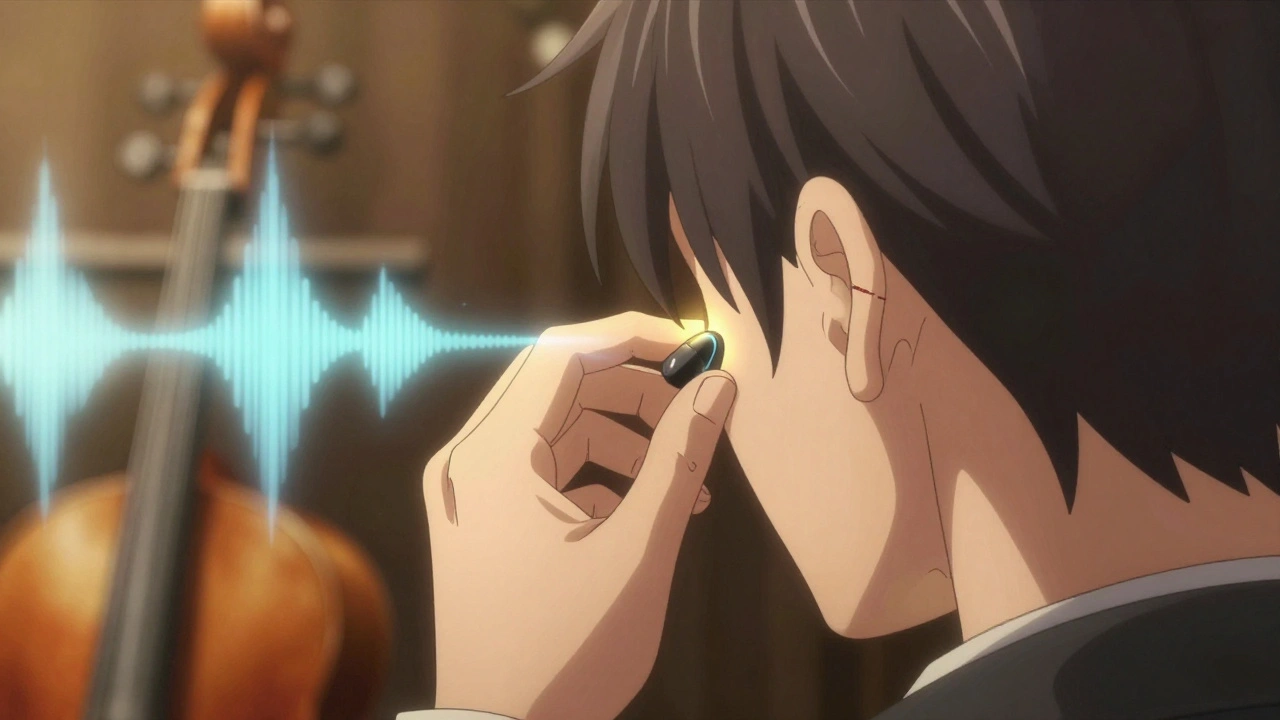
And it’s not just concerts. Musicians are at high risk. A 2022 survey found that 63% of professional musicians have some degree of hearing loss. Orchestral musicians often face 89-94 dBA during performances. That’s not a one-time thing-it’s every rehearsal, every show, year after year. And many don’t wear protection because they say it mutes the music. But modern musician earplugs are designed to reduce volume evenly across frequencies. They don’t make music sound dull-they make it safer.
How Hearing Protection Really Works
Not all earplugs are created equal. Foam plugs you buy at the drugstore can reduce noise by 20-30 dB-if they’re inserted correctly. Most people don’t insert them right. NIOSH studies show that without proper training, only 40% of workers use hearing protection effectively. But with hands-on training, that jumps to 85%.Custom-molded earplugs, used by musicians and industrial workers, offer better fit and sound quality. They’re made from silicone or acrylic impressions of your ear canal. They’re more expensive-$50 to $200-but last years. Electronic earplugs can even let you hear speech clearly while blocking harmful noise. At a factory, you can still hear your coworker yell “Watch out!” But the jackhammer’s roar? Gone.
Headphones and earmuffs work too. Earmuffs are great for short-term use, like at a shooting range. But for all-day wear, they can get hot and uncomfortable. The best solution? Combine them. Double protection-earplugs under earmuffs-can add another 10-15 dB of protection. That’s the go-to for workers near jet engines or heavy presses.
What You Can Do Right Now
You don’t need to wait for your employer or a venue to act. Here’s what you can do today:- Know your noise levels. Use a free smartphone app like NIOSH’s Sound Level Meter. It’s accurate within 2 dB of professional gear. Point it at your environment-your workplace, your car stereo, your concert-and see what you’re really hearing.
- Carry earplugs. Keep a pair in your pocket, your bag, your car. Silicone or foam, doesn’t matter. If it’s loud and you’re going to be there longer than 15 minutes, use them.
- Take breaks. After 30 minutes of loud noise, give your ears 10 minutes of quiet. Walk outside. Sit in a quiet room. Let your ears reset.
- Check your hearing. If you’re regularly exposed to loud noise, get a baseline hearing test. Then get one every year. Look for changes in your ability to hear high-pitched sounds-like birds chirping, doorbells, or children’s voices.
- Speak up. If your workplace is loud and no one’s doing anything, ask about the hearing conservation program. If you’re at a concert and there’s no earplugs or sound display, tell the staff. Demand better.
The Bigger Picture: Why This Matters
Hearing loss isn’t just about missing a song. It’s about isolation. It’s about not hearing your grandchild say “I love you.” It’s about missing the sound of rain, a door closing, or your own voice. In the U.S., 24% of all hearing loss is caused by noise-and it’s 100% preventable.Every year, workers’ compensation claims for hearing loss cost over $1 billion. The hearing protection industry is growing fast-$2.1 billion in 2023-and that’s not because people are buying more gadgets. It’s because more people are realizing they’ve been ignoring a silent threat.
The future is changing. California already follows NIOSH’s 85 dBA standard. The European Union is moving to extend workplace protections to concert staff. Spotify and Apple Music now warn you when your headphones are too loud. These aren’t just policies-they’re signs that society is finally waking up.
But change won’t happen unless you act. Your ears don’t get a second chance. Once the hair cells in your inner ear are damaged, they don’t grow back. You can’t fix it with medicine. You can’t cure it with surgery. The only thing that works is stopping the damage before it starts.
What’s Next for Noise Safety
Look for new rules coming soon. The European Commission is proposing updates to its noise directive in 2024 that would require venues to monitor sound levels for employees. In the U.S., OSHA is increasing inspections of music venues after a 40% spike in hearing loss complaints from musicians between 2019 and 2022.By 2040, experts predict that if 85 dBA becomes the universal standard-across factories, construction sites, and concerts-we could prevent 240,000 cases of hearing loss every year in the U.S. alone. That’s not a distant dream. It’s a math problem. And the solution is simple: reduce exposure time, lower volume, and protect your ears.
You don’t need to be a scientist or a safety officer to make a difference. You just need to care enough to use earplugs. To speak up. To check your hearing. To say no to loud music when you don’t have to be there. Your ears will thank you-for the rest of your life.
What noise level is considered dangerous for hearing?
Any continuous noise at or above 85 decibels (dBA) for 8 hours or more can cause permanent hearing loss. For every 3-decibel increase above 85 dBA, safe exposure time is cut in half. So at 88 dBA, you’re safe for only 4 hours. At 100 dBA, like a rock concert, your limit is just 15 minutes.
Is OSHA’s noise limit safe?
OSHA’s legal limit is 90 dBA for 8 hours, but it’s not considered safe by health experts. NIOSH, the leading research agency on workplace health, recommends 85 dBA as the maximum safe level. OSHA’s 5-decibel exchange rate underestimates risk at higher volumes by up to 700%, according to the American College of Occupational and Environmental Medicine. Following OSHA alone puts you at higher risk than following NIOSH guidelines.
Do earplugs really work at concerts?
Yes-and they’re better than ever. Standard foam earplugs reduce noise by 20-30 dB. Musicians’ earplugs use special filters to lower volume evenly across all frequencies, so music still sounds natural. Studies show that people who wear them at concerts report less ringing and better long-term hearing. Many festivals now offer them for free, and uptake rates reach 75% when they’re easy to access.
Can smartphone apps measure noise accurately?
Yes. NIOSH developed a free app called Sound Level Meter that’s been tested against professional equipment and found to be 92% accurate. Other apps like Decibel X also work well. They won’t replace lab-grade tools, but they’re good enough to tell you if your environment is above 85 dBA and whether you need protection.
How often should I get my hearing checked?
If you’re regularly exposed to noise above 85 dBA-whether at work or at concerts-you should get a baseline hearing test within six months of first exposure. After that, get tested every year. Early signs of hearing loss show up as trouble hearing high-pitched sounds like birds, doorbells, or children’s voices. Catching it early means you can take action before it gets worse.
Are there quiet zones at concerts?
Some venues now offer quiet zones-areas where sound levels are kept between 70 and 75 dBA. These are designed for people who need a break from the noise. You can rest, chat, or just let your ears recover. They’re becoming more common at large festivals and are often marked with signs or staffed by volunteers. Ask at the information booth if one is available.
Can hearing loss from noise be reversed?
No. Once the tiny hair cells in your inner ear are damaged by loud noise, they don’t regenerate. That’s why noise-induced hearing loss is permanent. There are no pills, surgeries, or devices that can restore lost hearing. The only effective treatment is prevention-reducing exposure and using protection before damage occurs.


14 Comments
Shannara Jenkins
December 3, 2025Just got back from a concert last weekend and I actually used those musician earplugs I bought last year. Honestly? The music still sounded amazing, but my ears didn’t feel like they’d been punched by a bass drum. I didn’t even realize how much I’d been ignoring this until I tried it.
Joel Deang
December 3, 2025omg yes!! i got a pair of those fancy plugs for my bday and now i cant believe i ever thought they were uncool. also my phone app says my airpods are at 98db when i listen to rap lmao 😅
Roger Leiton
December 5, 2025Did you know that the average rock concert hits 110-120 dB? That’s like standing next to a jet engine during takeoff. And yet people think it’s normal to walk out of a show with ringing ears. We treat our ears like they’re disposable. It’s wild. I started wearing plugs at gigs after my cousin got tinnitus-now I carry them everywhere. Even to the gym. Turns out, the treadmill speakers are louder than you think.
Laura Baur
December 6, 2025Let’s be honest-this isn’t about hearing protection. It’s about control. Society has normalized sensory overload. We’ve turned every public space into a sonic warzone because convenience trumps comfort. The fact that we need to be told to protect our ears from music is a symptom of a culture that commodifies experience over well-being. You don’t need earplugs-you need boundaries. And if your workplace doesn’t enforce NIOSH standards, it’s not negligence-it’s malice. The law is a floor, not a ceiling. And we’re barely scraping the floor.
Jack Dao
December 7, 2025Wow. So now I’m supposed to feel guilty for enjoying music? Next you’ll tell me I shouldn’t drive because cars emit CO2. People are dying from silence these days, you know. Let me enjoy my bass without a lecture.
Arun kumar
December 8, 2025in india we dont have much awareness. my cousin works in factory and he says no one gives him earplugs. he just shouts louder to be heard. sad.
Zed theMartian
December 9, 2025Oh great. Another article telling me what to do with my ears. Next you’ll ban loud cars, loud dogs, and loud children. The world is loud. Deal with it. Or move to a library. I’m not wearing plastic plugs to a Metallica show like some sad, obedient robot.
Ella van Rij
December 9, 2025Wow. I didn’t realize I was a hearing loss statistic until you pointed out my AirPods are set to ‘screaming in a hurricane.’ Thanks for the guilt trip, Dr. Noise.
ATUL BHARDWAJ
December 10, 2025Earplugs work. Use them. Simple.
Rebecca M.
December 10, 2025Oh my god. I just realized I’ve been listening to podcasts at 90 dB while driving. I’m basically slowly going deaf to my own life. I need a nap and a pair of plugs. And maybe a therapist.
Alicia Marks
December 12, 2025Best advice ever: carry plugs. I keep a pair in my purse, my car, and my work bag. No excuses. Your ears will thank you.
Paul Keller
December 12, 2025While the science is sound and the recommendations are well-documented, the real barrier to behavioral change lies not in ignorance but in cultural conditioning. We have been socialized to equate volume with value-louder music = more intense experience, louder machinery = more productive work. This is a deeply ingrained perceptual bias that cannot be corrected by pamphlets or apps alone. It requires systemic re-education, policy enforcement, and the normalization of quiet as a form of self-respect. The fact that we must argue for basic auditory hygiene in the 21st century is a failure of public health infrastructure, not individual willpower.
Elizabeth Grace
December 14, 2025I used to think earplugs were for old people or nerds. Then I went to a festival and came home with a headache that lasted three days. Now I wear them like a badge of honor. I’m not weak-I’m wise.
Steve Enck
December 14, 2025While the article correctly identifies the physiological mechanisms of noise-induced hearing loss, it fails to address the sociopolitical underpinnings of regulatory inaction. The discrepancy between NIOSH and OSHA standards is not an oversight-it is a calculated concession to industrial lobbying. The $2.1 billion hearing protection market is not a triumph of public health-it is the commodification of preventable harm. The true solution is not earplugs, but the dismantling of profit-driven negligence. Until then, we are all complicit.