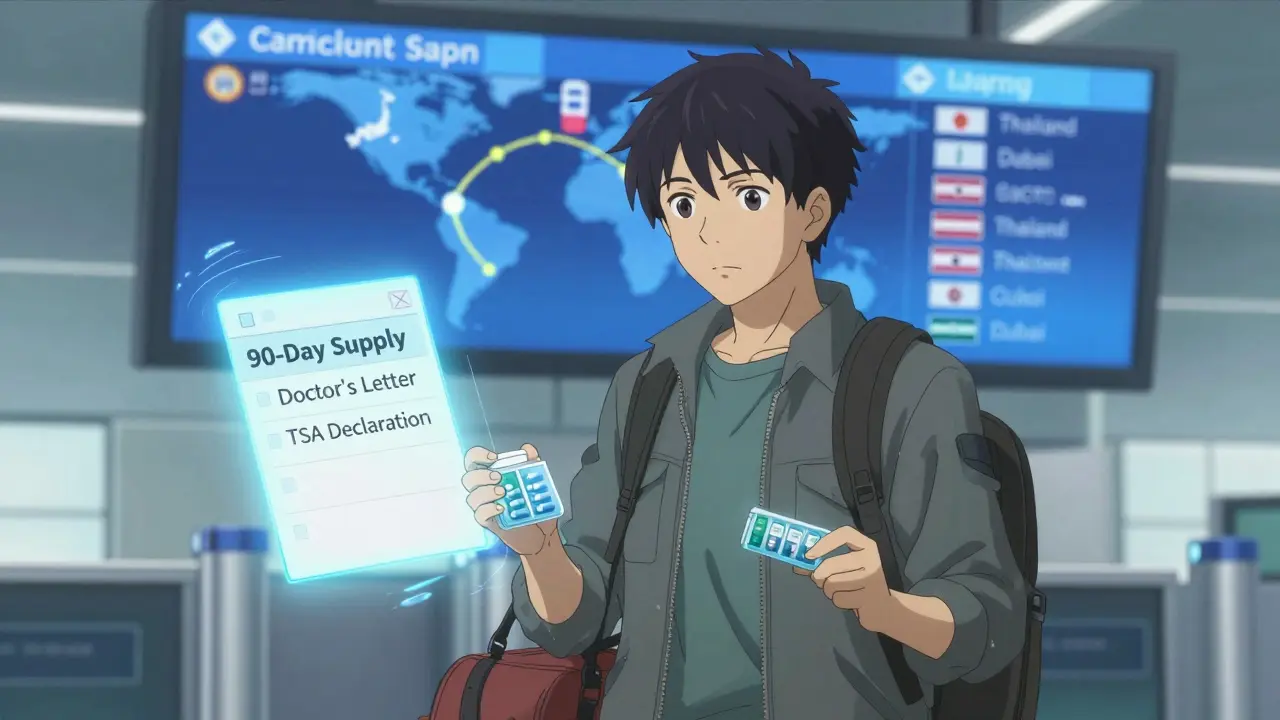
Running out of medication while traveling isn’t just inconvenient-it can be dangerous. Whether you're on a six-month backpacking trip or a two-week business tour, missing doses can trigger serious health setbacks. The good news? With the right prep, you can avoid this entirely. Most people don’t realize how much control they actually have over their meds while on the road. Here’s how to make sure your prescriptions stay covered, no matter where you go.
Start Early-At Least 30 Days Before You Leave
Waiting until the last minute is the biggest mistake travelers make. Pharmacies need time to process requests, insurers need to approve overrides, and international rules can take weeks to navigate. The CDC recommends starting your medication planning at least 30 days before departure. That’s not a suggestion-it’s a safety net. If you’re taking a chronic medication like blood pressure pills, insulin, or thyroid hormones, contact your pharmacy 14 days out. Ask for a vacation override. Most major U.S. insurers now allow this. UnitedHealthcare, Aetna, and CVS Caremark all permit early refills up to 7 days before your current supply runs out. Some, like Blue Cross Blue Shield of Michigan, even let you refill up to 14 days early. You’ll need to provide your travel dates and destination. A simple email or phone call is usually enough.Ask for a 90-Day Supply
If your doctor agrees, get a 90-day supply upfront. It cuts refill trips in half. A 2021 Kaiser Permanente study of 45,000 travelers showed that those who got 90-day supplies had a 67% drop in refill-related stress. Not all insurers allow this, but many do for maintenance medications. Controlled substances (like opioids or Adderall) are trickier. In 48 states, pharmacy boards enforce a 28-day rule-you can’t refill a 30-day prescription until 2 days after you’ve used it. That means if you’re leaving for 60 days, you’ll need two separate prescriptions. Talk to your doctor about splitting your supply. If you’re flying, pack your 90-day supply in your carry-on. TSA allows medically necessary liquids over 3.4 ounces if you declare them at security. Ninety-eight percent of U.S. airports accept this without issue.Double Your Containers-And Your Safety
Losing your meds is a nightmare scenario. Dr. Jennifer Schaefer from the American Pharmacists Association says it plainly: "Take your medication in two separate containers that you keep in two separate places." That means don’t pack all your pills in one bag. Put half in your carry-on, half in your checked luggage. Keep one set in your wallet or daypack. If your suitcase gets lost, you still have a backup. Use pill organizers labeled with your name and the drug’s generic name. Don’t rely on original bottles alone-those can get damaged or mislabeled. A 2023 GoodRx survey found that 41% of travelers forgot meds at home. Double containers cut that risk by more than half.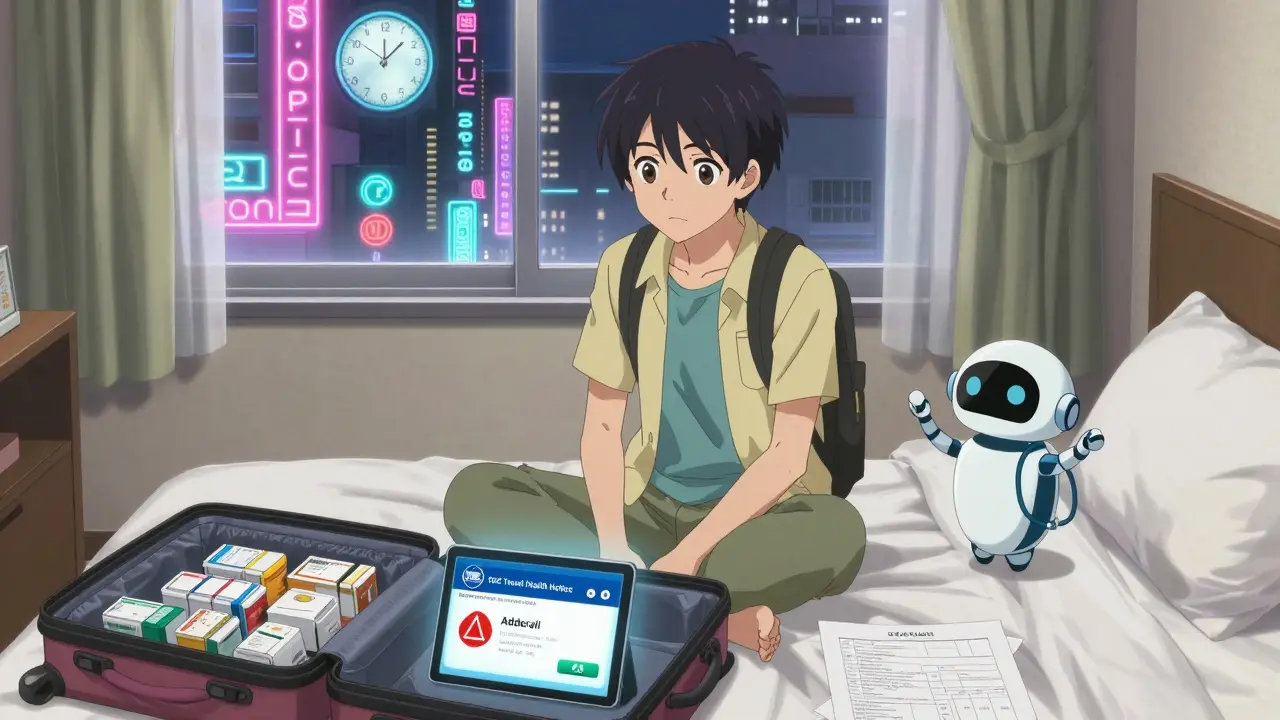
Know the Rules for International Travel
This is where things get complicated. Over 78 countries require a written prescription to bring in medication. Sixty-three have strict quantity limits. Thailand, for example, caps opioid prescriptions at 30 days. Japan bans many common ADHD and anxiety meds. The U.S. prescription doesn’t automatically work abroad. You need three things: a copy of your original prescription, a letter from your doctor on letterhead explaining why you need the meds, and a notarized translation if you’re going to a non-English-speaking country. Check the embassy website of every country you’ll visit-including layovers. The CDC’s 2023 Travel Health Notices now include country-specific medication rules for all 195 UN-recognized nations. Don’t assume your meds are legal just because they’re legal at home. A 2023 survey found that 67% of travelers ran into issues abroad, mostly with controlled substances. Schedule II drugs (like oxycodone or Adderall) are the hardest to get internationally-only 56% of travelers successfully obtained refills.Use Telehealth for Emergencies
What if you lose your meds? Or they get stolen? You have options. Telehealth services like Teladoc and Amwell handled over 1.2 million emergency prescription renewals in 2022. Many pharmacies also offer transfer services. If you’re in the U.S., CVS, Walgreens, and Rite Aid can refill your prescription at any location if you have remaining refills. You just need to call ahead and confirm stock. For international emergencies, local pharmacies can often help if you have your doctor’s letter and prescription copy. In countries like Canada, the UK, or Australia, you can often get a short-term supply with a foreign prescription. But in places like Brazil or Indonesia, you’ll likely need to see a local doctor first. Don’t wait until you’re sick. Have a plan B before you leave.Time Zones and Dosing Schedules
Changing time zones isn’t just about jet lag-it affects when you take your meds. The American Medical Association warns against adjusting your schedule too fast. If you’re crossing more than three time zones, stick to your home time zone for the first 24 to 48 hours. For example, if you take your blood pressure pill at 8 a.m. Eastern Time and fly to Tokyo (14 hours ahead), take it at 8 a.m. Tokyo time on day one. That’s still 8 p.m. back home. Wait two days before shifting to local time. The American Academy of Sleep Medicine says this reduces side effects and keeps your body’s rhythm stable. Use a phone alarm labeled "Meds: 8 a.m. EST" to stay on track.
What to Do If Your Insurance Denies a Refill
Sometimes, your insurer says no. If that happens, don’t panic. First, ask for a written denial letter. Then, call your pharmacy-they can often appeal on your behalf. CVS MinuteClinic, for instance, allows one-time 30-day renewals twice a year. In 2023, 79% of users who used this service called it "lifesaving." If you’re traveling internationally, you can also ask your doctor for a paper prescription to take with you. Many countries accept U.S. prescriptions if they’re accompanied by a doctor’s note. The key is persistence. A 2022 Express Scripts report found that 78% of medication-related travel emergencies were preventable with early planning. You’re not powerless here.Keep a Medication List
Always carry a printed or digital list of every medication you take. Include the generic name, brand name, dosage, frequency, and why you take it. Add your doctor’s name and phone number. This helps if you need emergency care abroad. A 2021 study in the Journal of Travel Medicine found that travelers who carried a medication list were 40% more likely to get appropriate care in a foreign hospital. Save this list on your phone and email a copy to a trusted contact. It’s one of the simplest, most effective steps you can take.Future Trends: What’s Coming Next
The system is getting better. By 2026, the FDA may approve cross-border digital prescription delivery. The International Pharmaceutical Federation is rolling out a global travel medication document in mid-2025. And 87% of insurers expect to offer universal vacation overrides by 2027. But until then, the responsibility is yours. The tools exist. The rules are clear. You just need to use them.Can I bring my medications on a plane?
Yes. TSA allows medically necessary liquids over 3.4 ounces if you declare them at security. Keep pills in their original bottles or labeled containers. Carry a copy of your prescription. You can pack them in checked or carry-on luggage, but never rely on just one location.
What if I run out of medication while abroad?
If you lose your meds overseas, contact the nearest U.S. embassy or consulate. They can help you find a local doctor or pharmacy. Bring your doctor’s letter and prescription copy. In many countries, a local doctor can write a new prescription if you have documentation. Telehealth services like Teladoc can also help if you’re in a country with coverage.
Do I need a doctor’s note for international travel?
For most countries, yes-especially if you’re carrying controlled substances. The note should be on your doctor’s letterhead, explain your condition, list your medications, and confirm they’re for personal use. Get it notarized if traveling to non-English-speaking countries. Always check the embassy website of each destination.
Can I get a refill at a foreign pharmacy?
Sometimes. In Canada, the UK, Australia, and parts of Europe, you can often get a short-term supply with a U.S. prescription and doctor’s note. In Asia, Latin America, or the Middle East, you’ll likely need to see a local doctor first. Never assume your U.S. prescription is valid abroad.
How do I handle time zone changes with my meds?
If you cross more than three time zones, stick to your home time zone schedule for the first 24 to 48 hours. For example, if you take a pill at 8 a.m. EST and fly to Tokyo, take it at 8 a.m. Tokyo time (which is 8 p.m. EST) on day one. After two days, adjust to local time. This helps prevent side effects and keeps your body’s rhythm stable.
Are there medications that are banned in certain countries?
Yes. Japan bans many ADHD and anxiety medications. Thailand limits opioid prescriptions to 30 days. Dubai prohibits many common painkillers. The CDC’s 2023 Travel Health Notices list country-specific bans. Always check before you go-don’t rely on general advice. A medication legal in the U.S. might be illegal abroad.
11 Comments
Milad Jawabra
March 3, 2026This is solid advice but let me tell you something real - I once lost my entire 90-day supply in a hostel in Thailand. Had to walk into a local pharmacy with a printout of my prescription and a Google Translate screenshot of my doctor’s note. They gave me a 30-day supply after a 2-hour wait. Don’t just plan - have a backup plan B, C, and D. 🤷♂️
Shivam Pawa
March 4, 202690-day supply works if your insurer allows it. But in India, even with a doctor's letter, most pharmacies won't honor foreign prescriptions. Better to carry original bottles with generic names printed clearly. No emojis. No drama. Just facts.
Donna Zurick
March 4, 2026I did the double container trick last year and it saved me when my suitcase got stuck in Atlanta. Half in my backpack half in my checked bag. Also labeled everything in big letters. No more panic. Just peace. ✨
Tobias Mösl
March 6, 2026Let’s be honest - this whole system is a scam. Pharmacies and insurers are playing you. They make you jump through hoops so they can charge you more later. And don’t get me started on the CDC - they change their rules every 6 months. I stopped trusting anyone after my Adderall got confiscated in Dubai. They called it a 'narcotic.' It was my ADHD med. The system is broken. 🔥
tatiana verdesoto
March 7, 2026I love how you mentioned the medication list. I carry mine in my wallet AND on my phone AND emailed to my sister. It’s such a simple thing but it made me feel so much more in control when I was in Mexico and had to rush to a clinic. You’re not alone out there. 💛
Ethan Zeeb
March 8, 2026I’ve been traveling for 12 years. I don’t rely on insurance. I don’t trust pharmacies. I get my meds in bulk, split them, and carry them in sealed ziplocks. No bottles. No labels. Just the pills and a handwritten note. TSA doesn’t care. They scan it and move on. This isn’t rocket science. It’s survival.
Darren Torpey
March 10, 2026Yo, this post is like a superhero guide to not becoming a medical casualty on the road. I used to be the guy who forgot his meds in a Paris hotel bathroom. Now? I’ve got my pills in my sock drawer, my purse, and my jacket lining. I even have a backup pill organizer shaped like a dinosaur. Because why not? 🦖💊 Life’s too short for dumb mistakes.
Lebogang kekana
March 11, 2026I took my insulin to South Africa last year. The pharmacy at Johannesburg airport said no to my U.S. script. But when I showed them my doctor’s letter and my blood sugar log from the last 6 months? They gave me a 14-day supply for free. Human kindness still exists. Don’t be afraid to ask. It’s not weakness - it’s wisdom.
Jessica Chaloux
March 12, 2026I cried when my meds got stolen in Bali. I felt so alone. Then a stranger at the pharmacy handed me a bottle of my exact pill. Said she’d been there too. I didn’t even know her name. Just hugged her. We both cried. Medication isn’t just pills. It’s life. And sometimes, strangers are the only ones who get that. 💔❤️
Mariah Carle
March 13, 2026The real truth? We’re all just temporary guests in our own bodies. Medication is the quiet rebellion against chaos. The pill is the poem you take daily to keep the storm at bay. You don’t manage refills - you negotiate with fate. And if you’re lucky? Fate lets you win. 🌌
Justin Rodriguez
March 14, 2026For anyone crossing time zones - don’t switch immediately. Stick to home time for 48 hours. I learned this the hard way after missing a dose of my thyroid med during a 16-hour flight. Ended up in an ER in Frankfurt. The nurse told me: 'Your body doesn’t care about your itinerary.' She was right. Simple. Effective. Don’t overthink it.