
When you're living with Crohn's disease or ulcerative colitis, conventional treatments like steroids and immunomodulators often fall short. They might reduce symptoms temporarily, but they don't stop the immune system from attacking your gut. That's where IBD biologics come in. These aren't just stronger drugs-they're precision tools designed to block specific parts of the immune response causing inflammation. Today, three main classes of biologics dominate treatment: anti-TNF agents, anti-integrin therapies, and IL-12/23 inhibitors. Each works differently, has different risks, and fits different patient needs.
Anti-TNF Inhibitors: The First Wave of IBD Biologics
Anti-TNF drugs were the first biologics approved for IBD, and they're still the most widely used. These medications target tumor necrosis factor-alpha (TNF-α), a protein that drives inflammation in the gut. Infliximab (Remicade) hit the market in 1998 for Crohn's, followed by adalimumab (Humira) in 2007. Today, they're the backbone of IBD treatment for many patients.
Infliximab is given as an IV infusion-usually at a clinic-starting with doses at weeks 0, 2, and 6, then every 8 weeks after. Each session takes 2 to 4 hours. Adalimumab, on the other hand, is a self-injected shot every other week after an initial loading dose. That convenience makes it popular, even if it's slightly less effective in some studies.
But there's a catch. Anti-TNF drugs carry a higher risk of serious infections, including tuberculosis and fungal infections. The FDA requires a REMS program for these drugs, meaning patients must be screened for latent TB before starting. Some people also develop antibodies to the drug over time, leading to loss of response. That's why doctors sometimes combine them with azathioprine or 6-MP-this combo can cut antibody formation by up to 70%.
Biosimilars like Inflectra and Cyltezo have lowered costs by 15-30%, making these treatments more accessible. Still, a single dose of infliximab can cost over $5,000 without insurance. For many, manufacturer assistance programs bring out-of-pocket costs down to $0-$5 per infusion.
Anti-Integrin Therapies: Targeting the Gut, Not the Whole Body
Unlike anti-TNF drugs, which suppress the immune system broadly, anti-integrin therapies like vedolizumab (Entyvio) are designed to work only in the gut. They block integrins-molecules that help immune cells travel from the bloodstream into inflamed intestinal tissue. This targeted approach means fewer systemic side effects.
Vedolizumab is given as an IV infusion at weeks 0, 2, and 6, then every 8 weeks. It takes longer to work-most patients don't feel full benefit until weeks 6 to 10. But for those who've had infections or neurological issues with other biologics, it's a game-changer. Unlike natalizumab (which carries a rare but deadly risk of PML, a brain infection), vedolizumab has no known central nervous system risks.
Patient reviews on MyIBDTeam show 72% report effectiveness with vedolizumab, and only 18% experience side effects. That's significantly better than adalimumab, where 58% report injection site reactions. But the slow onset frustrates some. One Reddit user wrote, "Switched from Humira to Entyvio after 5 years-no more weekly injections but had to wait 10 weeks for full effect, which was brutal."
It's not perfect. A 2022 study found patients on vedolizumab had higher rates of IBD-related hospitalizations than those on anti-TNFs. But for patients with psoriasis, multiple sclerosis risk, or a history of serious infections, vedolizumab is often the safer first choice.
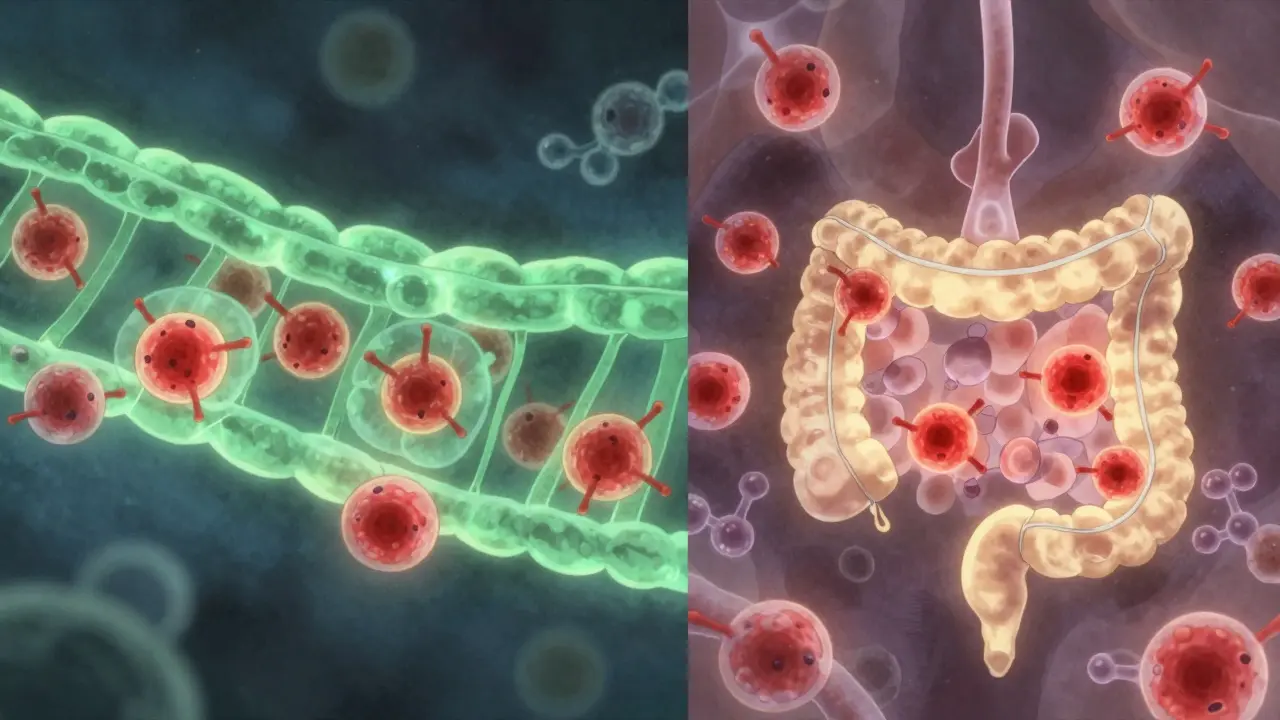
IL-12/23 and IL-23 Inhibitors: The New Frontier
Interleukin inhibitors are the newest class of IBD biologics. Ustekinumab (Stelara), approved for Crohn's in 2016 and ulcerative colitis in 2019, blocks both IL-12 and IL-23. It's given as a subcutaneous injection every 8 or 12 weeks, depending on weight. It's effective, especially for patients who failed anti-TNFs. But the real breakthrough came with drugs that target only IL-23: risankizumab (Skyrizi) and mirikizumab (Omvoh).
Risankizumab got FDA approval for ulcerative colitis in June 2024, making it the first IL-23 inhibitor approved for both Crohn's and UC. In the ADVENT trial, 29% of UC patients achieved clinical remission at 52 weeks-compared to just 10% on placebo. That’s a big jump. And because it targets only IL-23, not IL-12, it avoids some of the immune side effects linked to broader suppression.
Mirikizumab was approved for UC in 2022 and is now being tested for Crohn's. Both drugs are self-injected monthly or every few months, with fewer reports of serious infections than anti-TNFs. Early data suggests they may be more effective than ustekinumab for inducing deep remission, especially mucosal healing.
Cost is still high: a single 130mg dose of ustekinumab runs about $7,200. But the long-term safety profile looks promising. With no black box warnings for TB or cancer, and no need for strict pre-screening, these drugs are becoming first-line options for many patients.
Which Biologic Is Right for You?
There's no one-size-fits-all answer. But here’s how experts are thinking about it in 2025:
- If you have moderate-to-severe Crohn's and want the fastest, strongest response, infliximab still has the strongest evidence base.
- If you hate clinics and can handle self-injections, adalimumab is convenient-but expect more injection site pain and slightly lower efficacy.
- If you’ve had infections, psoriasis, or neurological concerns, vedolizumab is often the safest bet.
- If you’ve failed anti-TNFs or want a newer option with fewer side effects, risankizumab or mirikizumab are top contenders.
Some patients start with one drug and switch later. A 2024 Lancet study found 30% of IBD patients need to try two or more biologics within five years. That’s not failure-it’s just how complex the disease is.
Doctors now use tools like network meta-analyses to compare drugs across trials, but experts warn these studies have limits. Head-to-head trials are still rare. The upcoming RHEA and VEGA trials, expected to deliver results by 2026, could finally give us clearer answers.

Practical Realities: Cost, Time, and Daily Life
Choosing a biologic isn't just about science-it's about your life.
Infusions mean scheduling every 8 weeks, traveling to a clinic, sitting for hours, and sometimes dealing with infusion reactions (rash, fever, chills). One patient said, "Remicade worked within 2 weeks, but the 8-hour round trip every 8 weeks is unsustainable long-term."
Self-injections are faster but come with their own stress. About 22% of patients develop injection anxiety. Training with a nurse usually helps, but it’s still a daily reminder of your condition.
Cost is another major hurdle. Even with insurance, 41% of patients report high out-of-pocket expenses. Manufacturer programs help-Janssen’s CarePath program says 95% of eligible patients pay $0-$5 per infusion. But not everyone qualifies. Insurance denials are common, and appeals can take weeks.
Support tools matter. Apps like MyTherapy help 68% of patients stay on track with doses and appointments. The Crohn’s & Colitis Foundation’s IBD Help Center (888-694-8872) offers free counseling, financial aid guidance, and peer support.
What’s Next for IBD Biologics?
The pipeline is full. Etrolizumab, another anti-integrin drug, is in phase 3 trials with promising remission rates. More IL-23 inhibitors are on the way. Experts predict these drugs will make up 30% of the biologic market by 2028.
But the real future is personalization. Researchers are looking at biomarkers-like blood proteins or gut tissue changes-that could predict which drug will work best for you before you even start. That means less trial and error, fewer side effects, and faster relief.
For now, the choice comes down to balancing speed, safety, convenience, and cost. There’s no perfect drug. But there’s a better one for you-and knowing the differences between anti-TNF, anti-integrin, and IL-12/23 inhibitors is the first step to finding it.
How long does it take for IBD biologics to start working?
Timing varies by drug. Anti-TNF agents like infliximab and adalimumab often start working in 2 to 4 weeks. Vedolizumab and other anti-integrin drugs take longer-typically 6 to 10 weeks before you notice full improvement. IL-23 inhibitors like risankizumab may show early signs of improvement around week 6, but full effect can take up to 12 weeks. Patience is key, but if you see no change after 12 weeks, talk to your doctor about adjusting your plan.
Can I switch from one biologic to another if the first one stops working?
Yes, switching is common and often necessary. About 30% of patients need to try a second or third biologic within five years. If you lose response to an anti-TNF, switching to vedolizumab or an IL-23 inhibitor like risankizumab is a standard next step. The key is timing-your doctor will check for antibodies or inflammation markers before switching. Some patients respond better to drugs from a different class than their first.
Are biosimilars as good as the original biologics?
Yes. Biosimilars like Inflectra (infliximab-dyyb) and Cyltezo (adalimumab-adbm) are highly similar to the original drugs in structure, safety, and effectiveness. They undergo strict FDA testing to prove they work the same way. Many patients switch without any change in symptoms or side effects. The main difference is cost-biosimilars are 15-30% cheaper, which can make a big difference for long-term treatment.
Do I need to get vaccines before starting a biologic?
Absolutely. You should be up to date on all age-appropriate vaccines before starting any biologic. This includes flu, pneumonia, shingles (non-live version), hepatitis B, and COVID-19. Live vaccines like MMR or varicella are not safe once you’re on treatment. Your doctor will review your vaccine history and may give you shots several weeks before your first infusion or injection.
What are the biggest risks of using IBD biologics?
The biggest risk across all biologics is serious infection-like tuberculosis, pneumonia, or fungal infections. Anti-TNF drugs carry the highest risk, followed by ustekinumab. IL-23 inhibitors like risankizumab have lower infection rates. Other risks include infusion or injection reactions, increased skin cancer risk (rare), and, for natalizumab, a small chance of PML. Regular blood tests and screenings help catch problems early. Always report fevers, coughs, or unexplained rashes to your doctor right away.
Can I use biologics if I have other autoimmune conditions?
It depends. Anti-TNF drugs can help with psoriasis or rheumatoid arthritis alongside IBD-but they might worsen multiple sclerosis or cause new neurological symptoms. Vedolizumab is safer for patients with MS or neurological history because it doesn’t cross into the brain. Ustekinumab is sometimes used for psoriasis and IBD together. Always tell your doctor about all your conditions before starting treatment. A drug that helps one autoimmune issue might hurt another.