
When you have cutaneous lupus, sunlight isn’t just uncomfortable-it can wreck your skin and send your whole body into flare mode. It’s not a simple sunburn. It’s an autoimmune reaction triggered by something as ordinary as sitting near a window or walking to your car. And if you’ve ever been told, "It’s just sensitivity," you know how wrong that is. This isn’t about being fair-skinned or forgetting sunscreen. This is about your immune system overreacting to ultraviolet light in ways that leave lasting damage.
Why Sunlight Turns Into a Skin Bomb
- UVB rays cause DNA damage in skin cells at 2.3 times the rate in lupus patients compared to people without the disease.
- UVA rays, which pass through glass and most clothing, are just as dangerous-and often ignored.
- When skin cells die from UV exposure, they release molecules that trick the immune system into attacking healthy tissue.
- Interferon-kappa, a signaling protein made by skin cells, spikes by 400-600% after UV exposure, turning the skin into an inflammatory zone.
The Three Faces of Lupus Skin Damage
Not all cutaneous lupus looks the same. The type of rash you get tells you which version of the disease you’re dealing with-and how much sunlight is fueling it.- Acute Cutaneous Lupus (ACLE): The classic "butterfly rash" across the cheeks and nose. Seen in 85% of patients after UV exposure. It fades without scarring but can signal a systemic flare.
- Subacute Cutaneous Lupus (SCLE): Red, ring-shaped or scaly patches, often on arms, neck, or torso. 92% of these cases are triggered by sun exposure. It doesn’t scar but is strongly linked to Ro/SSA antibodies.
- Chronic Cutaneous Lupus (Discoid): Thick, scaly, raised lesions that scar and change skin color. Sun exposure doesn’t always create new ones, but it makes existing ones worse. 76% of discoid patients see flare-ups with UV exposure.
What’s Really in the Light? (It’s Not Just the Sun)
You don’t need to be outside to get hit. Fluorescent lights in offices, classrooms, and even some LED bulbs emit UVA and UVB. Reddit users with lupus report 74% being triggered by indoor lighting. One person wrote: "I got a full malar rash after 15 minutes sitting by a window at work." That’s not exaggeration. Glass blocks UVB but lets UVA through-enough to trigger flares. Even LED bulbs aren’t always safe. A 2023 study found that standard fluorescent bulbs emit UV radiation at levels high enough to affect lupus patients. Replacing them with LEDs labeled "UV-free" reduces exposure by 92%. If you spend hours under office lighting, this isn’t optional-it’s medical necessity.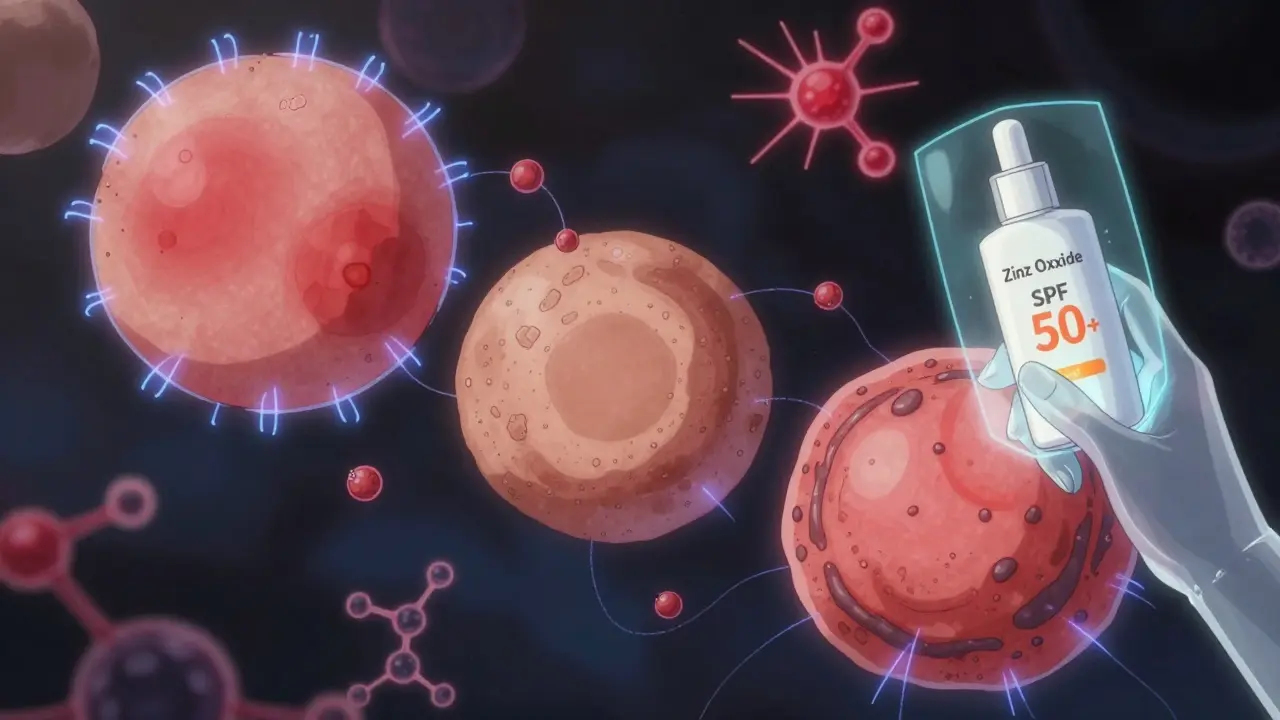
What Actually Works to Protect Your Skin
The good news? You can cut flare-ups by 70% with the right protection. But most people do it wrong.- Sunscreen: Use SPF 50+ with zinc oxide or titanium dioxide. Chemical sunscreens (like avobenzone) break down under UV and don’t block UVA well. Mineral sunscreens stay stable and shield both UVA and UVB. Reapply every 2 hours-even if it’s cloudy. Consistent use reduces flares by 87%.
- Clothing: Regular cotton blocks only 30-50% of UV. UPF 50+ clothing blocks 98%. Look for long sleeves, wide-brimmed hats, and UV-blocking scarves. Brands like Coolibar and Solumbra are designed for this.
- Windows: Install UV-blocking film on home and car windows. It cuts UVA transmission by 99.9%. You don’t need to live in the dark-just shield the light.
- Eyes: Photophobia is common. FL-41 tinted glasses reduce glare and light-triggered headaches by 68%. They’re not just for migraines-they’re for lupus too.
When Sunscreen Isn’t Enough: Medical Treatments
If your skin keeps breaking out despite perfect protection, you need more than sunscreen. Topical treatments can help-but they’re not magic.- Topical calcineurin inhibitors (tacrolimus, pimecrolimus): Reduce inflammation without thinning skin like steroids. Great for face and neck.
- Antimalarials (hydroxychloroquine): The backbone of lupus care. They don’t cure it, but they reduce skin lesions by 50-70% and lower flare risk. Most patients take it daily for life.
- Anifrolumab: A newer biologic approved in 2021. It blocks interferon receptors. In trials, photosensitive patients saw 34% greater improvement in skin symptoms than those on placebo.
- JAK inhibitors: Still in trials but promising. They cut interferon signaling and reduced photosensitivity reactions by 55% in early studies.

What No One Tells You
Many patients say their doctors dismissed their photosensitivity as "just sensitivity." A 2022 survey found 58% of lupus patients had their concerns ignored by primary care doctors. That’s dangerous. Ignoring UV triggers leads to more scarring, more flares, and more organ damage over time. Workplaces are starting to catch up. Companies like Microsoft and Johnson & Johnson now install UV-filtering film in 76% of their North American offices. That’s because they’ve seen the cost of absenteeism and disability when lupus flares go untreated. And here’s the truth: you don’t have to live in the dark. You don’t have to avoid all sun. You just need to be smart. A 10-minute walk at 8 a.m. or 5 p.m. is low-risk. Midday sun? Not worth it. A sunny balcony? Install film. Office lights? Swap them out.What’s Next: Smart Protection
The future of managing photosensitivity isn’t just sunscreen and pills-it’s tech. Three wearable UV monitors are now in clinical trials. They track real-time UV exposure and send alerts to your phone when you’re at risk. Early versions are 92% accurate at predicting flare risk. For people who’ve spent years guessing what triggered their rash, this could be life-changing. The science is clear: UV exposure isn’t just a trigger-it’s a driver of disease progression in cutaneous lupus. But the tools to fight it are here. And they work-if you use them consistently.Can I get lupus skin flares from indoor lighting?
Yes. Fluorescent and some LED lights emit UVA and UVB radiation. Studies show 74% of lupus patients report flares triggered by office lighting. Replacing bulbs with UV-free LEDs reduces exposure by 92% and can prevent daily flare-ups.
Is SPF 30 enough for cutaneous lupus?
No. SPF 30 blocks about 97% of UVB, but not enough UVA. For cutaneous lupus, use SPF 50+ with zinc oxide or titanium dioxide. These mineral sunscreens offer broader protection and don’t break down under sun exposure like chemical filters.
Do I need to wear sunscreen on cloudy days?
Yes. Up to 80% of UV radiation penetrates clouds. Many lupus flares happen on overcast days because people skip sunscreen. Consistent daily use reduces skin flares by 87%.
Can hydroxychloroquine help with skin symptoms?
Yes. Hydroxychloroquine is the first-line treatment for cutaneous lupus. It reduces skin lesions by 50-70% and lowers the risk of systemic flares. It takes 3-6 months to work fully, but most patients see improvement within 8 weeks.
What’s the difference between ACLE and discoid lupus?
ACLE causes a red, flat butterfly rash on the face that fades without scarring. Discoid lupus causes thick, scaly patches that scar and change skin color. ACLE is often linked to systemic flares; discoid lupus is mostly skin-limited but worsens with sun exposure.
Photosensitivity isn’t a side effect of cutaneous lupus-it’s one of its core drivers. The better you protect your skin from UV, the less your immune system has to fight. And when you combine smart sun habits with proven medical treatments, you’re not just managing symptoms-you’re taking back control.

14 Comments
John Smith
March 4, 2026Sunlight ain't just a trigger-it's a goddamn weapon. I got a malar rash from sitting by a window with blinds half-closed. No sunburn, no sweat, just woke up looking like I got into a fight with a UV beam. And yeah, my doc called it 'sensitivity.' I called him an idiot and left. Mineral sunscreen? Non-negotiable. UPF shirts? I wear them to bed. This isn't lifestyle advice-it's survival.
Sharon Lammas
March 4, 2026I read this carefully. It made me think about how little we understand about invisible triggers. The body doesn't always scream before it breaks. Sometimes it just... changes. A rash. A tiredness. A flare. And then we're told it's all in our head. But the science here is quiet proof: our skin remembers. And it fights back. We don't need more hype. We need more listening.
Donna Zurick
March 5, 2026Just started using Coolibar shirts and I swear I haven't had a flare in 3 months. Seriously. I used to think sunscreen was enough. I was wrong. The clothing? Game changer. Also, UV film on my car windows? Best $80 I ever spent. I'm not a nerd about this-I just want to live outside without paying for it later.
Pankaj Gupta
March 6, 2026The data presented here is methodologically sound and aligns with peer-reviewed literature on interferon-kappa upregulation in cutaneous lupus. The 74% statistic regarding indoor lighting is particularly compelling, as it corroborates findings from the 2023 photobiology study published in JID. I would only suggest supplementing with a reference to the 2021 anifrolumab phase III trial (NCT03435789) for completeness.
Richard Elric5111
March 7, 2026It is, perhaps, a matter of profound existential gravity that the human organism, in its delicate equilibrium, is rendered vulnerable by the very photons that sustain life. One cannot help but reflect upon the irony: the sun, that ancient giver of warmth and growth, has, in the context of autoimmunity, become an agent of cellular disintegration. The scientific elucidation presented herein, while clinically precise, evokes a metaphysical unease.
Dean Jones
March 7, 2026I’ve been living with this for 12 years. I used to think I was just being dramatic. Then I started tracking my flares. Every single one-every single one-linked to UV exposure. Even on ‘cloudy’ days. Even in my basement. Even from my laptop screen. I got a biopsy once. The pathologist said, ‘This isn’t eczema. This is lupus. And you’ve been ignoring it.’ I didn’t cry. I just bought a UV meter. Now I know exactly when to go inside. It’s not paranoia. It’s precision.
Betsy Silverman
March 7, 2026I’m so glad this got written. I’ve had people tell me to ‘just get over it’ because I won’t go to the beach. I’ve had coworkers say I’m ‘weird’ for wearing a hat indoors. But here’s the thing: I’m not weird. I’m informed. And I’m not alone. My sister has discoid lupus. She has scars on her scalp from years of ignoring this. We need more awareness. Not pity. Just… understanding.
Ivan Viktor
March 9, 2026So let me get this straight. I’m supposed to live like a vampire because my immune system is having a temper tantrum? Cool. I’ll just sit in a dark room with a tinfoil hat and sip chamomile while the rest of you enjoy the world. Seriously though-UV-free bulbs? That’s a thing? I’m replacing every bulb in my house. If I have to be a lab rat, at least let me have decent lighting.
Zacharia Reda
March 10, 2026You know what’s wild? Hydroxychloroquine isn’t just for malaria. It’s basically the Swiss Army knife of lupus. I started it six months ago. Didn’t feel much at first. Then one day I looked in the mirror and realized-my face wasn’t red. Not even a little. I didn’t even notice until it was gone. That’s the thing about this stuff: it doesn’t scream. It just quietly fixes things. Also, FL-41 glasses? Yes. My headaches vanished. No joke.
Jeff Card
March 11, 2026I used to think I was being lazy when I avoided sunlight. Now I know I was being smart. I’ve had three flares. All three happened after I skipped sunscreen because it was ‘just cloudy.’ I didn’t realize how much UVA penetrates clouds. I thought clouds were a shield. They’re not. They’re a disguise. Now I put on sunscreen every morning. Rain or shine. It’s part of my routine like brushing my teeth.
Matt Alexander
March 12, 2026Simple answer: sunscreen + clothing + window film = 80% less flares. You don’t need fancy meds unless your skin is still breaking out. Start with the basics. Zinc oxide. UPF 50. UV film. Do that for 3 months. If you still flare, then talk to your doc. But most people skip the first three steps. That’s why they think nothing works.
Gretchen Rivas
March 13, 2026I got diagnosed with SCLE last year. The ring-shaped rash on my arms. I thought it was eczema. Took 6 months to get the right diagnosis. Once I started wearing long sleeves and UV film on my windows, the flares stopped. I didn’t need meds. Just protection. I’m not brave. I’m just tired of being in pain.
Stephen Vassilev
March 14, 2026I have serious concerns about the commercialization of UV-blocking products. Who benefits? Corporations. Who profits? The sunscreen industry. The lighting industry. The clothing industry. Are we being manipulated into believing that the solution is to buy more things? Or is the real solution systemic-reducing industrial UV emissions? Are we being sold safety-or a placebo dressed in marketing? I have not been convinced.
Mike Dubes
March 14, 2026I just want to say thank you for writing this. I’ve been too scared to tell anyone how bad it is. I cry every time I have to skip a picnic. I wear gloves in summer. I’ve been told I’m overreacting. But now I have proof. And I’m not alone. I’m gonna get UV film for my house. And I’m gonna tell my boss about the office lights. I’m done hiding.