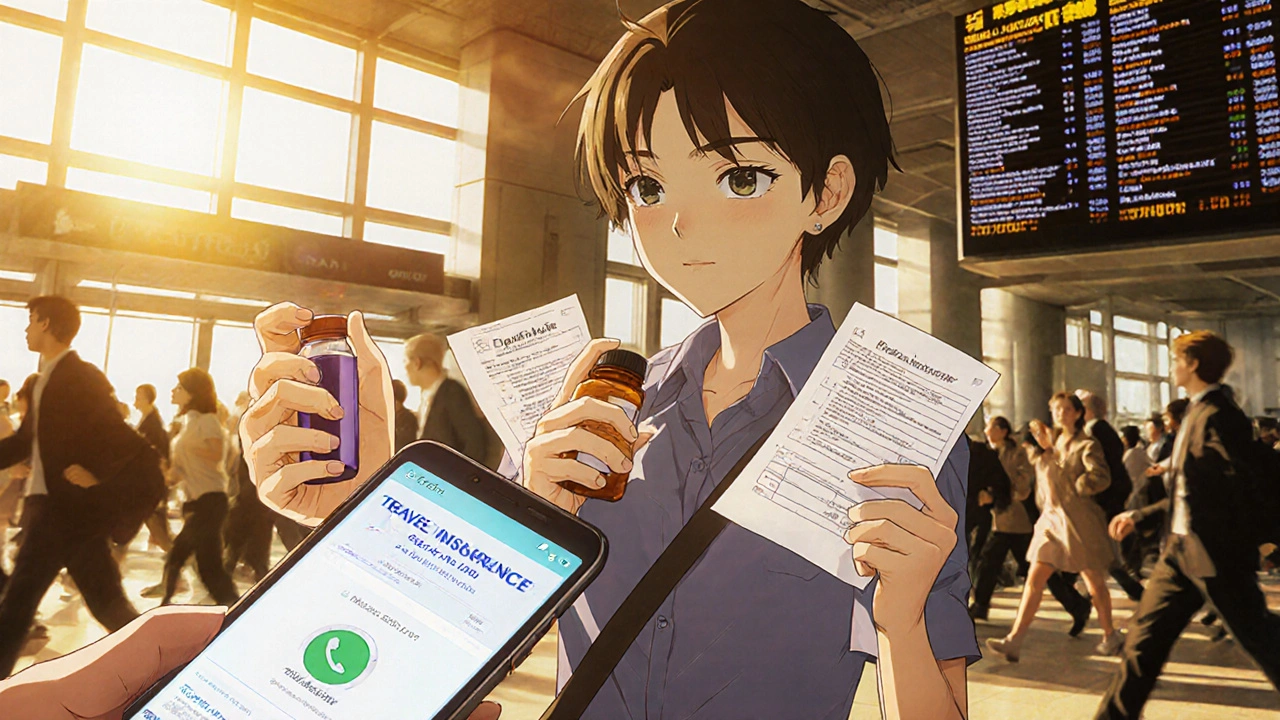
If you’re traveling and suddenly realize your medications are gone-stolen from your bag, lost in transit, or left behind in a hotel-you’re not alone. Thousands of travelers face this every year. The good news? You can get your meds replaced. But how you do it makes all the difference between a quick fix and a dangerous delay.
Don’t Panic. Do This First.
The moment you notice your meds are missing, stop and breathe. Panicking leads to bad decisions. Your first step? Contact your travel insurance provider. Most comprehensive plans-like those from Allianz, AIG, or Travel Guard-include 24/7 medical assistance. They don’t just give you a phone number; they send a team to handle the whole process. They’ll call your doctor, find a local pharmacy, verify your prescription, and even arrange a doctor’s appointment if needed. In fact, MedAire’s Global Health Response Team gets 89% of clients their meds within 12 hours. That’s not luck. That’s a system.If you don’t have travel insurance, move to step two: find your original prescription details. Do you have the name of the drug (generic, not brand), dosage, and your doctor’s contact info? If yes, you’re ahead of 60% of travelers. If no, you’re in a harder spot. A 2023 study in the Journal of Travel Medicine found that people without documentation took nearly four times longer to get replacements.
Carry a Doctor’s Letter (Even If You Think You Don’t Need It)
The U.S. Department of State and the International Society of Travel Medicine both say the same thing: carry a letter from your doctor. Not just a copy of your prescription. A letter. On letterhead. Signed. It should list:- Your full name and date of birth
- Each medication by generic name (e.g., “metformin,” not “Glucophage”)
- Dosage and frequency
- Why you need it (e.g., “for type 2 diabetes,” “for ADHD”)
- Your doctor’s name, license number, and contact info
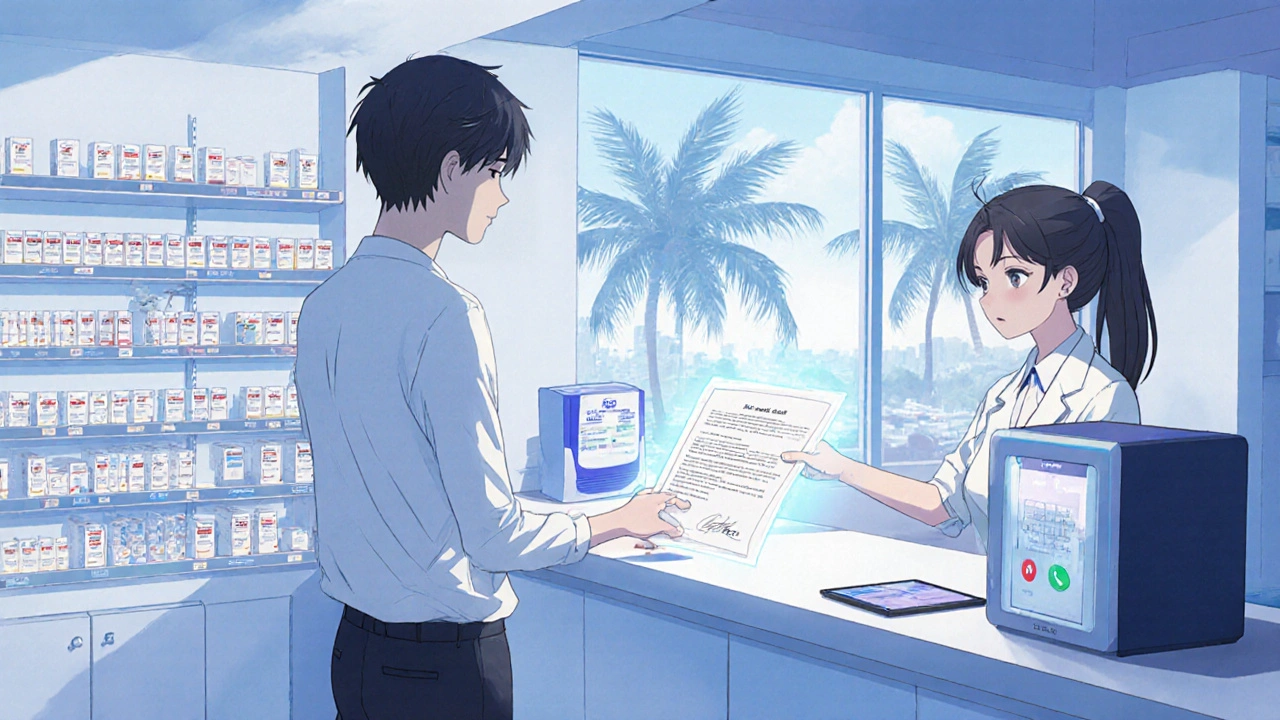
This isn’t bureaucracy. It’s your passport to getting meds abroad. In countries like Thailand or Japan, pharmacies can’t fill foreign prescriptions-even if they’re real. But if you show a doctor’s letter, they’ll often call your doctor directly to confirm. That’s how it works in 92% of cases, according to travel medicine specialists.
Controlled Substances Are a Different Battle
If you take Adderall, Ritalin, OxyContin, Vicodin, or any other Schedule II drug, you’re in a tougher spot. Under U.S. law, these can’t be refilled without a new prescription-even in the U.S. And overseas? It’s worse. Most countries treat them as illegal narcotics. You can’t walk into a pharmacy in Paris, Berlin, or Bangkok and say, “I need my Adderall.”The DEA and international drug control agencies are strict. Even if you have a letter from your doctor, local doctors in most countries won’t prescribe these to travelers. Your best bet? Call your U.S. doctor. Some may be able to send an emergency prescription to a U.S.-based telehealth service like MyUSADr. But here’s the catch: federal law (Ryan Haight Act) still bans telehealth prescriptions for controlled substances. So unless you’re back on U.S. soil, you’re out of luck. Plan ahead. Bring extra. Don’t risk it.
What If You’re in Europe vs. Southeast Asia?
Location matters. In the European Union, pharmaceutical rules are standardized under Directive 2001/83/EC. Pharmacies are used to dealing with foreign prescriptions. In cities like Barcelona, Amsterdam, or Prague, you can often get your meds within 24 hours if you have documentation. One Reddit user in November 2023 reported getting her blood pressure meds in Berlin within five hours-just by showing her doctor’s letter and a copy of her prescription.In Southeast Asia? It’s harder. Countries like Thailand, Indonesia, or Vietnam have stricter controls. Pseudoephedrine (in cold meds) is banned without a license. Codeine is OTC in the UK but prescription-only in the U.S. And counterfeit drugs? The WHO says they cause up to 500,000 deaths a year globally. In places like Cambodia or Nigeria, up to 30% of meds are fake. Never buy meds from street vendors. Even if the packaging looks real. Stick to licensed pharmacies-hospitals, chain stores like Watsons or Guardian, or those approved by local health ministries.
Temperature-Sensitive Meds? Bring a Backup Plan
Insulin, epinephrine pens, some biologics-they’re sensitive to heat. A 2023 survey by the International Diabetes Federation found that 41% of travelers had issues with meds losing potency after being left in hot luggage or exposed to direct sun. If you take insulin or similar drugs:- Carry at least a 7-day supply in your carry-on
- Use a portable cooler (like a Frio pack or insulated pouch)
- Ask your airline if they can store your meds in a fridge during layovers
- Know where hospitals or clinics are near your destination that carry insulin
Many hospitals in major cities stock common insulin types. But don’t wait until you’re out of meds to find out. Research ahead. Call the hospital’s pharmacy before you go. Save their number in your phone.
What to Do If Your Bag Is Lost by the Airline
If your checked bag disappeared and your meds were inside, act fast. Airlines are required under IATA Resolution 701 to respond to baggage claims within 24 hours. Go to the airline’s baggage service desk before you leave the airport. File a report. Get a reference number. Many airlines have partnerships with local pharmacies to provide emergency meds to stranded travelers. Some even cover the cost if you’re on a long delay.Don’t assume they’ll find your bag. In 2022, IATA reported 1 in 150 checked bags were mishandled. That’s not rare. Always keep meds in your carry-on. Always.
Costs and Insurance: What’s Covered?
Replacing meds abroad isn’t free. But it doesn’t have to break you. According to the U.S. Travel Insurance Association, 68% of comprehensive travel insurance plans cover prescription replacement-with limits between $500 and $1,000 per incident. Basic plans? Usually exclude it. Check your policy before you go.If you’re uninsured, here’s what you might pay (2023 Consumer Reports data):
- Western Europe: $75-$150
- Latin America: $120-$200
- Southeast Asia: $40-$90
Prices vary based on drug type and local availability. A 30-day supply of metformin might cost $25 in Thailand. The same in New York? $15. But you’re not in New York. You’re in Bangkok. And you need it now.

Digital Tools Can Help-But Don’t Rely on Them
Apps like Medisafe (used by over 5 million people) let you store digital copies of prescriptions with blockchain verification. Sounds great, right? But here’s the reality: only 17% of countries accept digital prescriptions as legal documentation. A QR code won’t help if the pharmacist doesn’t trust it. Use these tools as backups-not your main plan.Instead, print two copies of your prescriptions and doctor’s letter. Put one in your wallet. Put one in your carry-on. Leave one with a trusted person at home. That’s redundancy. That’s safety.
What If You Can’t Get Your Exact Meds?
Sometimes, the exact drug isn’t available. Your doctor might have prescribed “Lisinopril 10mg,” but the local pharmacy only has “Enalapril.” Are they the same? Not exactly. But they’re in the same class. Your local doctor can substitute if they know your history. That’s why the doctor’s letter is so important. It tells them your condition, your history, your allergies. Without it, they won’t risk it.For chronic conditions like diabetes, hypertension, or epilepsy, 76% of international physicians require an in-person consult before prescribing anything new. They don’t want to mess up your care. So be patient. Give them time. Bring your old bottles. Show your blood sugar logs. Make it easy for them to help you.
Final Rule: Prevention Is Your Best Medicine
The CDC’s 2024 Yellow Book says 31% of medication-related travel emergencies could’ve been avoided. Here’s how to be one of them:- Bring a 14-day extra supply (in your carry-on)
- Keep meds in original bottles with pharmacy labels
- Carry a doctor’s letter with generic names
- Know your country’s rules on your meds (search “[country] + medication regulations”)
- Get travel insurance with medical assistance
- Save the number of your country’s embassy or consulate
Traveling with meds isn’t about luck. It’s about preparation. The people who get through this without panic? They planned ahead. You can too.
Can I get my prescription refilled at a foreign pharmacy?
Most countries won’t fill a foreign prescription. Even if the drug is legal there, pharmacies are required to verify the prescription with the prescribing doctor-and they can’t do that with U.S. or other foreign prescriptions. You’ll need to see a local doctor who can write a new prescription based on your medical history and documentation.
What if I lose my controlled substance like Adderall or OxyContin?
You cannot get these refilled abroad. U.S. federal law and most international drug regulations prohibit this. Your only options are to contact your doctor for an emergency prescription (if you’re near a U.S. consulate or can access telehealth from a U.S.-licensed provider), or wait until you return home. Never try to buy these on the street-they’re often counterfeit or illegal.
Is it safe to buy medications from local pharmacies abroad?
Only buy from licensed pharmacies-hospitals, chain stores like Guardian or Watsons, or those with official government approval. Avoid street vendors, unmarked shops, or online sellers. The WHO estimates up to 30% of drugs in some regions are counterfeit. Fake meds can be deadly.
Do I need to declare my medications at customs?
Some countries require you to declare prescription drugs, especially controlled substances. Check the destination country’s customs website before you travel. Always carry medications in their original bottles with your name on the label. This avoids suspicion and speeds up clearance.
What should I do if I’m stranded without meds and no insurance?
Contact your country’s embassy or consulate. They can often provide a list of local doctors and pharmacies. Call your prescribing doctor-many will email a letter or prescription to a local provider. If you have a chronic condition, go to a hospital emergency room. They’re required to stabilize you, even without insurance.


14 Comments
Mary Kate Powers
November 29, 2025Just got back from Bali and lost my insulin in transit. Had to walk into a hospital with my doctor’s letter and a half-melted Frio pack. They hooked me up with the same brand in 3 hours. Seriously, carry that letter. It’s not paperwork-it’s your lifeline.
Also, never trust those ‘pharmacy’ kiosks near tourist spots. One looked legit but the pills were chalky. I threw them out and cried.
You’re not weird for over-preparing. You’re smart.
Sara Shumaker
December 1, 2025There’s something deeply human about how we treat health as an afterthought until it’s gone. We pack the cute outfits, the fancy camera, the guidebook-but the pills? We toss them in a Ziploc like they’re snacks.
It’s not about bureaucracy. It’s about dignity. Your body doesn’t care if you’re on vacation. It needs its rhythm. The doctor’s letter? That’s not a formality-it’s a translation of your survival into a language the world will respect.
And if you’re taking something controlled? You’re not a criminal for needing it. You’re just a person who forgot to plan ahead. We’ve all been there.
Don’t shame yourself. Just learn. And carry two copies.
Scott Collard
December 3, 2025Anyone who says ‘just bring extra’ hasn’t flown with 14 days of Adderall in their carry-on. TSA will flag you. Customs will interrogate you. Your doctor won’t refill it overseas. And yes, I’ve done all three.
Stop pretending this is easy. It’s not. It’s a legal minefield wrapped in a medical emergency. And if you’re not prepared, you’re just gambling with your brain chemistry.
Also, ‘MedAire gets you meds in 12 hours’? Cute. I waited 48 in Prague. They had my drug. But refused to fill it without a local doctor’s signature. So I paid €180 for a 15-minute consult with a guy who didn’t speak English.
Plan. Or suffer.
Steven Howell
December 4, 2025As someone who has lived in five countries and managed chronic medication across four continents, I can confirm: the single most effective tool is the signed, letterhead doctor’s note. Not the prescription. Not the app. Not the QR code.
It must include: full legal name, date of birth, generic drug names, dosage, indication, physician’s license number, and direct contact information. No abbreviations. No email-only. No digital-only.
Pharmacies in Japan, Germany, and Brazil all require this. Even in places where local laws are lax, the pharmacist’s liability concerns override convenience.
Print it. Laminated. In a waterproof sleeve. In your wallet. Always.
And for insulin users: carry a note stating ‘This is life-sustaining medication.’ It helps.
linda wood
December 5, 2025Oh wow, so if I lose my ADHD meds in Thailand I’m just supposed to cry and wait for my U.S. doctor to magically email someone? That’s so helpful.
Meanwhile, my Thai coworker just bought Ritalin at the corner shop like it was candy. Guess I’m the one with the problem for following the rules.
Also, why does everyone act like the DEA is the world’s pharmacy regulator? Like, maybe the world doesn’t care about your U.S. schedule II drama?
Just saying.
...but yeah, bring extra pills. Obviously.
LINDA PUSPITASARI
December 7, 2025OMG I just lost my metformin in Barcelona 😭😭😭
Went to the pharmacy with my letter and they were like ‘oh honey yes we have it’ and gave me a whole month for 20 euros 😍
Also the lady hugged me and gave me a cookie 🍪
So yeah just carry the letter and dont panic
ps i use medisafe but also printed 3 copies bc i’m a mess
you got this 💪❤️
gerardo beaudoin
December 8, 2025My mom lost her blood pressure pills in Mexico. She called her doctor. He emailed a letter. She walked into a hospital. They gave her a week’s supply. No problem.
Don’t overcomplicate it. Just have the letter. Just know the generic name. Just go to a real pharmacy.
Also, don’t trust the hotel front desk. They don’t know anything.
And yes, carry extra. Always.
Joy Aniekwe
December 10, 2025Let me guess-you’re the kind of person who thinks a doctor’s letter is ‘enough’? In Lagos, they’ll ask for your passport, your visa, your Nigerian next of kin, your birth certificate, and your mother’s maiden name before they even look at your pill bottle.
And if you’re on antidepressants? Forget it. They’ll call the police.
So yes, bring extra pills.
And maybe don’t travel if you need meds that aren’t street-corner-available.
Just saying.
Also, your ‘comprehensive insurance’? Yeah, good luck getting them to pay in Abuja. They’ll say ‘not covered’ and hang up.
Latika Gupta
December 10, 2025why do people always think they are the only one who lost meds? i lost my thyroid pills in goa and just bought the same brand from a local chemist. they had it. no letter needed. no drama.
maybe you just need to chill and trust the world a little more.
also why are you so obsessed with paperwork? your body will survive.
Sullivan Lauer
December 12, 2025Let me tell you about the time I lost my insulin in Hanoi. I was alone. It was 3 a.m. I had one vial left. My Frio pack was dead. I walked five kilometers to the only hospital open. I showed them my letter. The nurse cried. She called her brother, who was a doctor. He came in pajamas. He gave me three vials. He didn’t charge me. He gave me his personal number. Said, ‘Call me if you need more.’
That’s not insurance. That’s not bureaucracy. That’s humanity.
Don’t just carry a letter. Carry your story. Carry your fear. Carry your hope.
And if you’re lucky? Someone will meet you there.
Not every country is a system. But every country has people.
Don’t forget that.
Sohini Majumder
December 13, 2025OMG I can't believe people actually do this? Like, who even carries a doctor's letter?? Like I'm supposed to just... print it?? and carry it?? and then... wait??
Also, why is everyone so obsessed with 'generic names'? Like, who even knows what metformin is?? I just know it's the white pill that makes me not diabetic!!
And why are we talking about Adderall like it's nuclear material?? I saw a guy buy it in Bangkok with cash and a smile!!
Also, I lost my meds in Bali and just bought some from a guy on the beach. He said it was 'the same thing' and I'm still alive!!
So yeah, maybe the real problem is you guys being too serious about everything??
Just chill. The world is not out to get you. Probably.
...but still, bring extra. Just in case. I guess.
tushar makwana
December 15, 2025in india we have a saying: ‘dawa ki dukaan, har jagah hai’-medicine shops are everywhere. i lost my blood pressure pills in delhi and got them in 20 minutes. no letter, no drama.
but i also know people who died because they trusted fake pills from street vendors.
so maybe the answer is not ‘never trust’ but ‘know where to trust’.
ask the local pharmacist: ‘is this same as this?’ and show them your bottle.
most of them will help. they’ve seen it all.
and yes, carry extra. always.
but don’t panic. the world is kinder than we think.
Richard Thomas
December 16, 2025It is imperative to underscore that the prevailing regulatory architecture governing pharmaceutical substitution across international jurisdictions remains fundamentally incompatible with the unilateral administrative protocols of the United States Food and Drug Administration. Consequently, any reliance upon digital documentation or non-compliant prescriptive formats constitutes a material deviation from internationally recognized pharmacovigilance standards, thereby exposing the individual to significant clinical and legal liability.
Furthermore, the notion that a physician’s letter constitutes sufficient legal instrumentality under the European Union’s Directive 2001/83/EC is, in fact, demonstrably erroneous. While such documentation may facilitate expedited consultation, it does not, under any circumstance, constitute a valid prescription under the terms of Article 46 or Annex I.
It is therefore not merely prudent-it is a bioethical obligation-to carry a minimum of a 21-day surplus of all controlled and non-controlled substances, stored in original, labeled containers, accompanied by a notarized copy of the prescribing physician’s license and a certified translation into the local language, certified by a member of the International Association of Medical Translation.
Failure to comply with these standards is not negligence. It is recklessness.
And if you are traveling with Schedule II substances, you are not a patient. You are a walking federal violation.
Plan accordingly.
Mary Kate Powers
December 17, 2025Just read the one about the nurse in Hanoi. That’s the part I needed to hear.
I forgot to bring my extra insulin. I thought I’d be fine. I wasn’t.
But when I walked into that hospital, the nurse didn’t ask for paperwork. She asked if I was scared.
I said yes.
She handed me the vials and said, ‘Good. That means you’re still alive.’
Thanks for reminding me that systems fail-but people don’t.