
Over 1.5 billion people worldwide live with some level of hearing loss. For many, hearing aids aren’t just helpful-they’re life-changing. But with so many types, fitting methods, and tech features on the market, choosing the right one can feel overwhelming. This isn’t about buying a gadget. It’s about finding a device that fits your ear, your lifestyle, and your hearing needs. Whether you’re considering an over-the-counter option or a custom-fitted prescription model, understanding how these devices work-and what’s changed in the last five years-is key to making the right choice.
What Are the Main Types of Hearing Aids?
Hearing aids come in five main styles, each with clear trade-offs between power, visibility, and ease of use.Behind-the-Ear (BTE) models sit behind the ear and connect to a custom earmold or dome that fits inside the ear canal. These are the most powerful and durable. Brands like Phonak’s Naída Lumity L-UP are built for severe to profound hearing loss, with IP68 water resistance and battery life lasting up to three weeks. They’re ideal for people with dexterity issues, since the larger size makes them easier to handle. But they’re also the most visible.
Receiver-in-Canal (RIC) devices are the most popular today. The speaker sits directly in the ear canal, connected by a thin wire to a small unit behind the ear. This design reduces feedback and improves sound quality. The Jabra Enhance Select 700 and Widex MOMENT SmartRIC are top RIC models. They offer 24+ hours of battery life, Bluetooth 5.2, and LE Audio support, which means better streaming and lower power use. RICs strike a balance between power and discretion.
In-the-Ear (ITE) models fill the outer ear bowl. They’re larger than RICs but smaller than traditional BTEs. Signia Active Pro IX delivers 34 hours of battery life and Bluetooth 5.2 in a single shell. These are great for people who want more features without the bulk of a BTE. But they’re not ideal for people with very small ears or those who sweat heavily.
Completely-in-Canal (CIC) and Invisible-in-Canal (IIC) styles are nearly invisible. Eargo’s IIC models are popular for their discreet design. But because they’re so small, they have tiny batteries-usually lasting only 16-20 hours-and fewer controls. You won’t find advanced features like noise cancellation or direct phone streaming on most IICs. They’re best for mild to moderate hearing loss and people who prioritize appearance over functionality.
How Are Hearing Aids Fitted?
Fitting isn’t just about plugging in a device. It’s a process that determines whether the hearing aid works-or just sits there unused.If you go the prescription route, you’ll typically need 3-4 appointments over 2-3 weeks. First, an audiologist runs a hearing test to map your exact hearing loss across frequencies. Then they pick a device based on your lifestyle-do you work in noisy offices? Do you love music? Do you need to hear your grandchildren clearly at dinner? After selection, the device is programmed using real-ear measurements, where a tiny microphone is placed in your ear canal to verify sound levels. Finally, you return for fine-tuning. This isn’t a one-time fix. Most people need 2-3 adjustments over the first month to get comfortable.
Over-the-counter (OTC) hearing aids like the Jabra Enhance Select 700 skip the clinic. You download an app, take a 5-minute hearing test on your phone, and the app automatically adjusts the device. HearingTracker’s tests show 85% of users complete this setup successfully on the first try. But here’s the catch: 68% of users in NIH trials got suboptimal amplification because they misjudged their hearing loss. Self-fitting works for mild-to-moderate loss, but if you’re struggling to hear in group settings or need help with high-frequency sounds, you’re better off with professional fitting.
What’s New in Amplification Technology?
Modern hearing aids aren’t just amplifiers. They’re mini-computers.Early digital aids had 8-12 processing channels. Today’s premium models like the Phonak Audéo Infinio Sphere use 24+ channels to fine-tune sound in real time. That means you hear a bird chirping clearly while still filtering out the clatter of dishes behind you.
The biggest leap? Dual-chip architecture. Traditional hearing aids process sound in one chip, causing a 5-7 millisecond delay. That delay makes speech sound unnatural, especially when you’re watching TV. Phonak’s dual-chip system cuts that delay to just 0.4 milliseconds. It’s so fast, your brain doesn’t notice the lag. Dr. Brian Taylor from HearingTracker calls it the current gold standard.
Then there’s AI-driven processing. Starkey’s Edge AI analyzes 290 million data points per second to recognize speech, music, and environments. It automatically switches modes-restaurant, car, quiet room-without you lifting a finger. Newer models even offer real-time language translation during conversations, thanks to cloud-connected processing.
LE Audio is another game-changer. Released in 2023, it’s the next-gen Bluetooth standard for hearing aids. It uses less power, supports multiple devices at once, and enables Auracast broadcasting. That means you can walk into a restaurant and stream the speaker’s voice directly to your hearing aids-even if others around you aren’t using them. Forty-two percent of Starkey Edge AI users now use Auracast regularly.
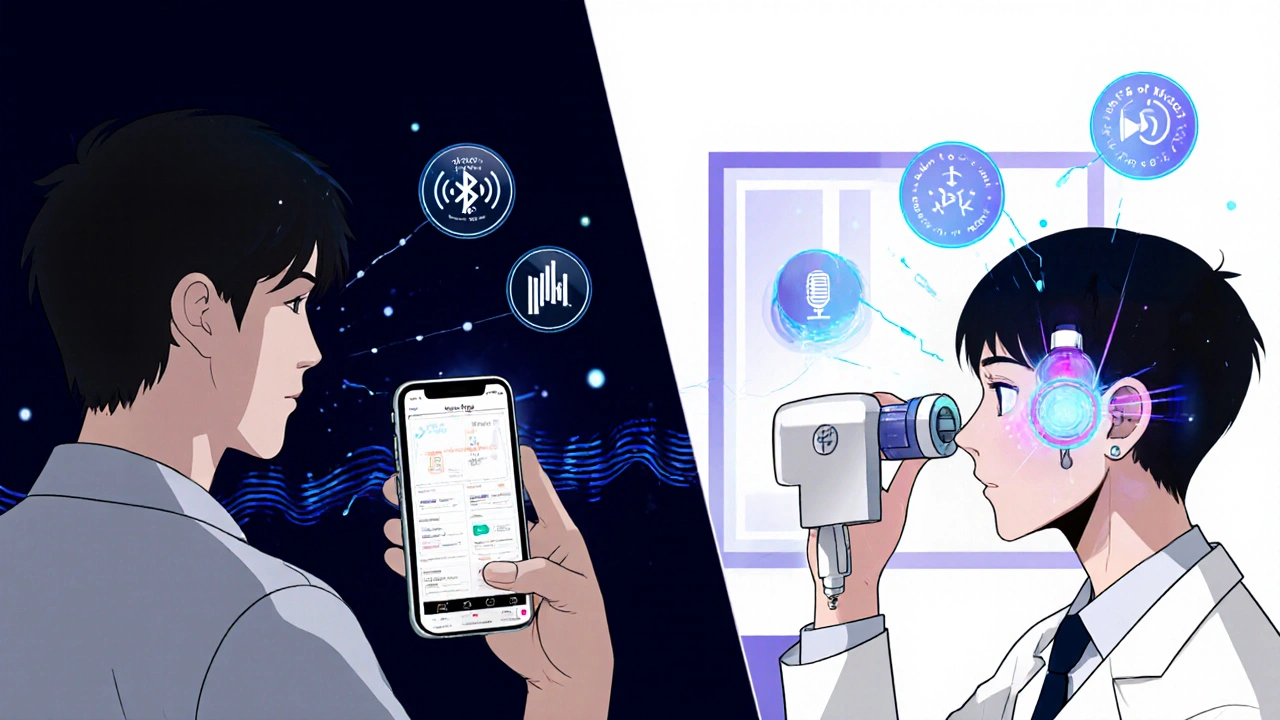
Price Differences: OTC vs. Prescription
Price isn’t just about the device-it’s about the service behind it.OTC hearing aids like Jabra Enhance Select 700 range from $199 to $1,299 per pair. You get the device, an app, and 24/7 chat support. Jabra resolves 92% of issues within 15 minutes. But you’re on your own for fitting and follow-ups.
Telehealth models (like those from Audicus or Eargo) cost $1,000-$3,500. You get remote consultations with an audiologist, but no in-person fitting. These are good for tech-savvy users who want some professional input without clinic visits.
Premium prescription devices from Phonak, Oticon, ReSound, Widex, Starkey, and Signia cost $3,500-$7,500 per pair. You pay for the device, the audiologist’s time, multiple fittings, and ongoing support. Phonak’s Audéo Infinio Sphere, for example, is priced at $6,000-$7,500. But it’s the only model with dual-chip processing and 24+ channels. If you need top performance, this is where you’ll find it.
Costco’s Rexton Reach models sit in the middle-at $1,399-$2,999. You get in-store support from trained staff, but not licensed audiologists. It’s a solid middle ground for budget-conscious buyers who still want hands-on help.
Real User Experiences and Common Pitfalls
People don’t just buy hearing aids. They live with them.On Reddit, 73% of users with LE Audio-enabled aids say music sounds clearer than ever. That’s huge. For decades, hearing aids made music sound tinny or distorted. Now, with LE Audio and better processing, it’s actually enjoyable.
But not all experiences are positive. Eargo users complain about battery life. Trustpilot reviews show 62% of negative feedback says the device lasts less than 16 hours-even though Eargo claims 20. Real-world use drains batteries faster, especially with Bluetooth streaming.
Phonak Naída Lumity L-UP users love the power, but 34% say the device is too big for small ears. If you have narrow ear canals, a BTE might be uncomfortable. Always try before you buy.
One of the most overlooked issues? Earwax. The American Speech-Language-Hearing Association found 42% of users experience monthly blockages. Cleaning your device weekly with the manufacturer’s tool reduces malfunctions by 67%. Keep a soft brush and wax loop handy.
And don’t ignore humidity. In Sydney’s humid climate, moisture kills batteries. A simple trick: keep silica gel packets in your hearing aid case overnight. It extends battery life and prevents internal corrosion.

What’s Coming Next?
The future of hearing aids is health, not just hearing.ReSound’s new Vivia platform uses MAV (Microphone Acoustic Vent) technology to reduce the “occlusion effect”-that plugged-up feeling when you speak. It cuts it by 45% compared to older models. That alone makes a huge difference in comfort.
Starkey’s 2026 roadmap includes blood oxygen monitoring and fall detection. Imagine your hearing aid alerting your family if you fall, or warning you if your oxygen levels drop during sleep. This isn’t science fiction-it’s already in development.
By 2027, 41% of buyers are expected to choose telehealth options. The market is shifting from clinic-based care to direct-to-consumer models. But that doesn’t mean professional help is obsolete. For complex cases, audiologists still deliver the best outcomes.
There’s one risk to watch: cybersecurity. University of Michigan research found 12% of Bluetooth-enabled hearing aids are vulnerable to signal interception. While no major breaches have occurred, manufacturers are working on encrypted connections. Always update your device’s firmware when prompted.
Choosing the Right Hearing Aid for You
Ask yourself these three questions:- How severe is my hearing loss? If it’s mild-to-moderate and you’re comfortable with tech, an OTC model like Jabra Enhance could work. If it’s moderate-to-severe, skip the DIY route.
- What environments matter most? If you’re often in noisy places, look for multi-microphone models with AI noise reduction. Avoid single-microphone designs like Oticon Intent miniRITE-they struggle in crowds.
- Do I want convenience or performance? OTC is easier and cheaper. Prescription is more powerful and personalized. Don’t choose based on price alone. Choose based on what you need to hear.
Don’t rush. Try before you buy. Many clinics offer 30-day trials. Use that time to test your device in real situations-family dinners, public transport, work meetings. Your hearing matters. Make sure your device does too.
Can I buy hearing aids without seeing a doctor?
Yes, over-the-counter (OTC) hearing aids are now legally available in the U.S. and many other countries for adults with perceived mild-to-moderate hearing loss. Brands like Jabra Enhance Select 700 let you take a phone-based hearing test and self-fit the device using an app. But if you have severe hearing loss, sudden hearing changes, ear pain, or tinnitus, you should still see an audiologist. OTC devices aren’t designed for complex cases.
How long do hearing aid batteries last?
Battery life varies by style and usage. BTE and RIC models with rechargeable batteries typically last 16-34 hours per charge. Smaller CIC and IIC models like Eargo last 16-20 hours. Factors like Bluetooth streaming, noise reduction, and humidity reduce battery life. Rechargeable models are now standard-most users charge them overnight. For longer life, store devices in a dry place with silica gel packets.
Are premium hearing aids worth the cost?
If you need high performance in noisy environments, yes. Premium models like Phonak Audéo Infinio Sphere use dual-chip processing, 24+ channels, and AI-driven sound optimization. These features make speech clearer and reduce listening fatigue. For someone who works in a busy office or loves social gatherings, the difference is noticeable. If you mostly stay at home or watch TV, a mid-tier device may be enough. Cost should match your real-world needs, not your budget.
What’s the difference between LE Audio and regular Bluetooth?
LE Audio is the next-generation Bluetooth standard designed specifically for hearing aids. It uses less power, supports higher audio quality, and enables Auracast broadcasting-allowing you to stream audio from public speakers, TVs, or phones directly to your hearing aids, even in group settings. Regular Bluetooth only connects one device at a time and drains batteries faster. If you stream music, watch videos, or attend events often, LE Audio is a major upgrade.
Why do some hearing aids make my voice sound too loud?
That’s called the occlusion effect. It happens when the hearing aid blocks your ear canal, making your own voice sound echoey or boomy. Newer models like ReSound’s Vivia platform use Microphone Acoustic Vent (MAV) technology to reduce this by 45%. If you’re using an older device, ask your audiologist about open-fit domes or venting options. For IIC models, this issue is common and may require switching styles.
How often should I replace my hearing aids?
Most hearing aids last 4-7 years. But you might need to replace them sooner if your hearing changes, the device stops working reliably, or newer tech offers features you need-like LE Audio or fall detection. Don’t wait until your device breaks. If you notice you’re turning up the volume more often or struggling in conversations, it’s time for a check-up. Hearing loss progresses slowly, and your device should evolve with you.





15 Comments
Olivia Currie
November 30, 2025This article literally changed my life. I got my first RIC last month and now I hear my cat purring from across the room. I cried. Not because I was sad-because I finally heard the little things again. 🥹
farhiya jama
December 1, 2025Why are we even talking about this? Hearing aids are just another corporate scam to make old people pay for overpriced plastic. I’d rather just yell louder.
Curtis Ryan
December 3, 2025OMG I JUST GOT MY JABRA ENHANCE 700 AND IT’S A GAME CHANGER!!! I didn’t know I was missing half the conversation at family dinners. Now I hear my niece say ‘I love you’ without her having to repeat it 12 times. Also, I spelled ‘amplification’ wrong in my notes but whatever. 🙌
Rajiv Vyas
December 3, 2025They’re hiding the truth. Hearing aids don’t help you hear better-they just let the government listen to you through your ear canal. LE Audio? More like LE Spying. You think that Auracast is for music? Nah. They’re streaming your thoughts to the cloud. Wake up, sheeple.
DENIS GOLD
December 4, 2025So you’re telling me a $7,500 hearing aid can translate languages? Cool. Meanwhile my iPhone does it for free. Guess I’m just too poor to be heard properly.
Sue Barnes
December 4, 2025If you’re buying OTC, you’re just wasting money. You clearly don’t know what real hearing loss looks like. I’ve been an audiologist for 28 years and I’ve never seen someone self-fit without regret. Don’t be that person.
Daniel Rod
December 4, 2025It’s wild how something so small can reconnect you to the world. I used to avoid parties. Now I laugh at jokes I actually hear. 🌱
gina rodriguez
December 5, 2025Just wanted to say thank you for this post. I’ve been putting off getting hearing aids for 3 years because I was scared. This made me feel like it’s okay to ask for help. I booked my appointment today. 💛
Ifeoma Ezeokoli
December 6, 2025In Nigeria, we don’t have access to most of this tech. But I’ve seen elders use old analog aids-some held together with tape-and still smile when they catch a grandchild’s voice. Tech matters, but humanity matters more.
Matthew Stanford
December 7, 2025For real, the occlusion effect is the worst. I thought I was going crazy until I found out it’s normal. Open-fit domes saved me. Also, silica gel packets are magic. Keep one in your case. Trust me.
Diana Askew
December 9, 2025LE Audio? More like LE Profit. They’re just selling you a new way to get hacked. And don’t get me started on Starkey’s ‘blood oxygen’ thing-that’s just a cover for selling you a fitness tracker with earbuds. Wake up!
Sachin Agnihotri
December 10, 2025Can we talk about how ridiculous it is that we’re paying $7,500 for a device that’s basically a Bluetooth speaker with a mic? I mean, come on. If you want to hear better, just turn up the TV. Or, I dunno, talk louder?
jobin joshua
December 11, 2025Bro, I got Eargo and the battery lasts like 12 hours max. They said 20. Lied. Also, the app crashes every time I try to adjust it. 😤
King Property
December 11, 2025You people are clueless. The real problem isn’t the tech-it’s the audiologists. They’re all in bed with the big hearing aid companies. They don’t want you to know you can get the same chip in a $200 device from China. The ‘professional fitting’? It’s just a money grab. I’ve seen the schematics. It’s the same damn processor. They just slap on a brand name and jack up the price. You’re being played.
Astro Service
December 12, 2025Why are we letting foreigners design our hearing aids? America used to make the best tech. Now it’s all Phonak from Switzerland and Starkey from Minnesota-wait, that’s still America. Fine. But Jabra? That’s Denmark. We need American-made hearing aids. Make America Hear Again.