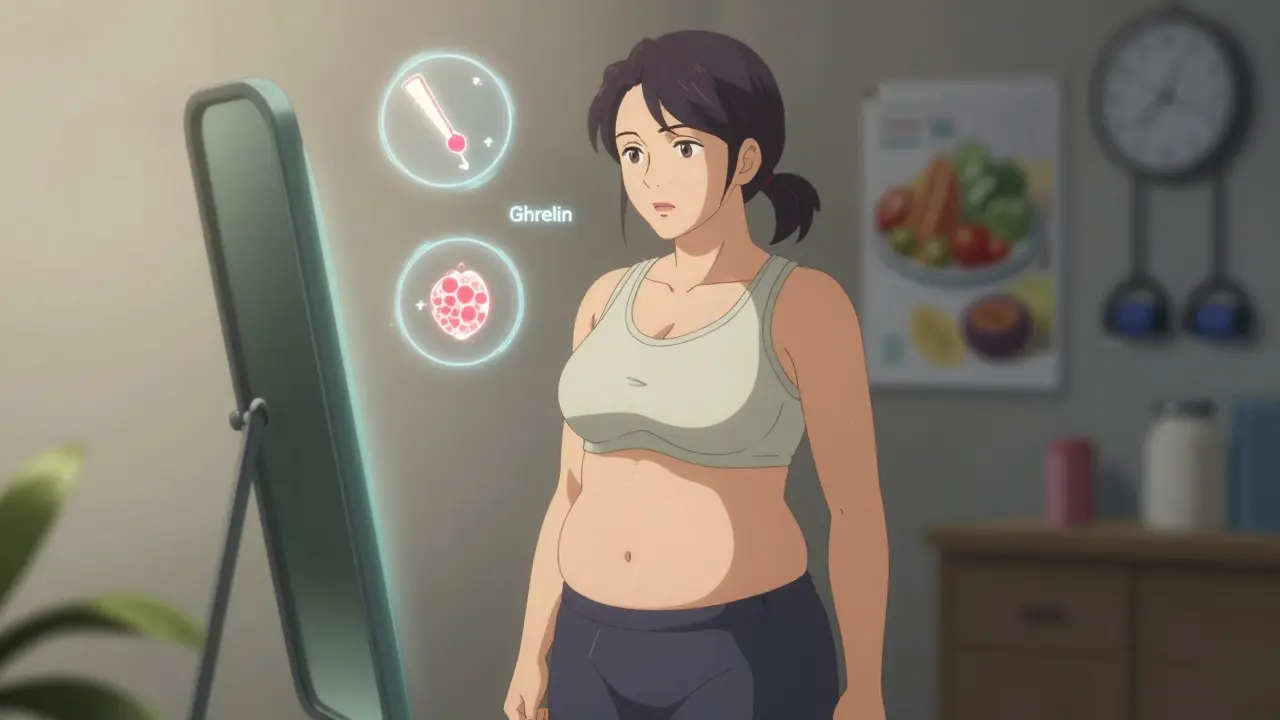
When you hit your late 40s or early 50s, you might notice something strange: your jeans don’t fit like they used to-even though you haven’t changed what you eat or how much you move. You’re not lazy. You’re not failing. Your body is going through a biological shift that’s been quietly rewriting your metabolism, fat storage, and muscle balance for years. This isn’t just about aging. It’s about menopause weight gain-a complex, hormone-driven process that affects nearly every woman.
Why Your Belly Gets Bigger Even If You Eat the Same
Before menopause, your body naturally stores fat in your hips, thighs, and buttocks. That’s estrogen at work. It tells fat cells to settle in those areas, which is why many women have a pear-shaped figure in their 20s and 30s. But as estrogen drops-by 60 to 70% during the menopausal transition-your body stops listening to those signals. Instead, fat starts moving to your abdomen. Visceral fat. The kind that wraps around your organs, not just sits under your skin. This isn’t vanity. It’s a health signal. Visceral fat is metabolically active. It pumps out inflammatory chemicals and makes your body resistant to insulin. That’s why postmenopausal women are nearly five times more likely to develop abdominal obesity than before menopause. And here’s the kicker: you can gain 1.5 kilograms (3.3 pounds) per year during perimenopause-even if your calorie intake hasn’t changed. Studies like SWAN, which tracked over 3,300 women for 20 years, proved it. Women who ate the same, exercised the same, still gained weight. The reason? Your resting metabolic rate drops by 2-3% every decade after 30. Menopause speeds that up.The Hormonal Domino Effect
Estrogen doesn’t just control fat location. It plays a role in appetite, sleep, and energy use. When it crashes, other hormones go out of whack. Leptin, the hormone that tells your brain you’re full, drops by 20-30%. Ghrelin, the hunger hormone, spikes by 15-25% because hot flashes and night sweats ruin your sleep. Poor sleep = more hunger. More hunger = more snacking, especially on carbs and sugar. At the same time, your testosterone levels, while still low, become relatively higher because estrogen has fallen so much. That shift pushes fat toward your midsection and makes it harder to build muscle. And muscle is your metabolism’s best friend. You lose 3-8% of lean muscle mass every decade after 30. Menopause adds another 1-2% loss per year. That means your body burns fewer calories at rest-even when you’re asleep.Muscle Isn’t Just for Strength-It’s Your Metabolic Lifeline
You don’t need to become a bodybuilder. But you do need to lift. Strength training isn’t optional anymore. It’s survival. Every pound of muscle you gain burns 6-10 extra calories per day. That might not sound like much, but over a year, that’s 2,000-3,000 extra calories burned. That’s the equivalent of running 30 miles. Research from Menopause: The Journal of The North American Menopause Society shows that women who did resistance training 2-3 times a week for six months gained 1.8-2.3 kg of lean muscle and lost 8-12% of abdominal fat. That’s not magic. That’s biology. Muscle responds to stress. Lift weights, use resistance bands, do bodyweight squats, lunges, push-ups. Don’t wait for motivation. Do it when you’re tired. Do it when you’re busy. Do it because your body needs it more than ever.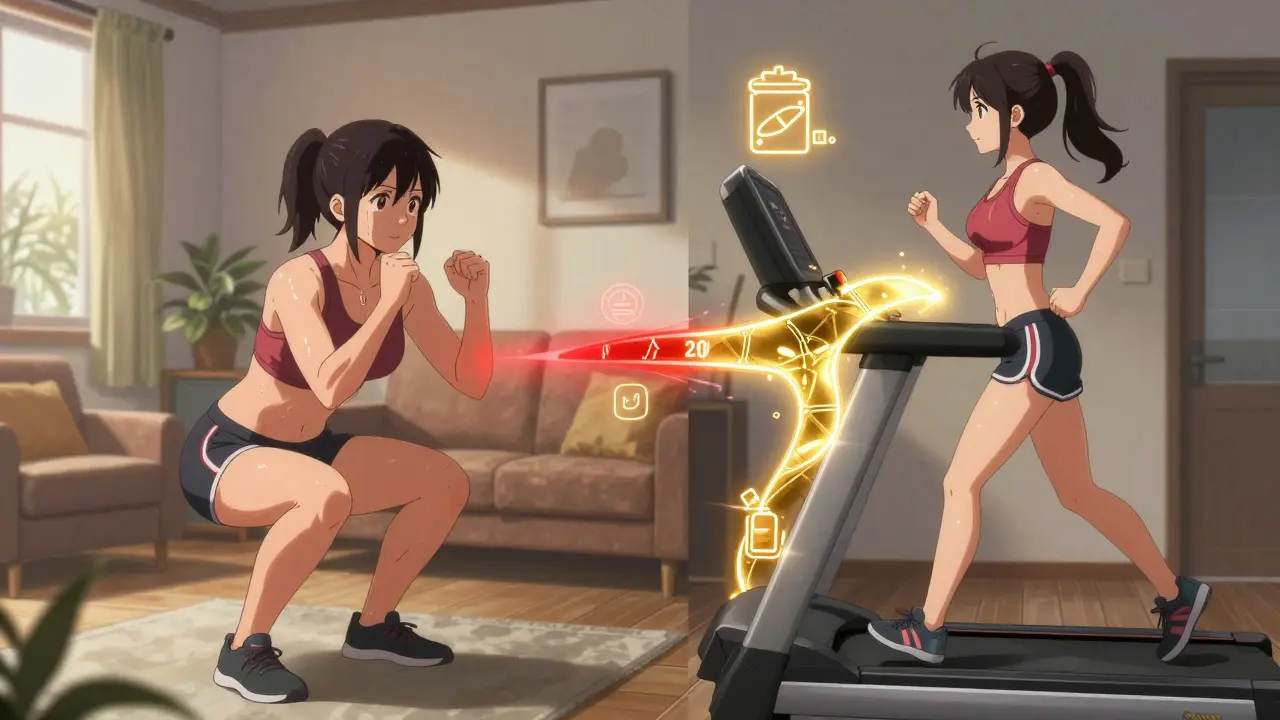
What to Eat-And What to Stop Doing
Forget low-fat diets. They don’t work anymore. Your body needs protein to rebuild muscle and stabilize blood sugar. Aim for 25-30 grams of protein per meal. That’s about three eggs, a palm-sized piece of chicken or fish, or a cup of lentils. Spread it out across breakfast, lunch, and dinner. Your muscles are more resistant to protein after 45. You need more to trigger growth. Cut back on processed carbs and sugary drinks. They spike insulin, and with lower estrogen, your body stores that energy as fat-especially around your waist. Swap white bread for whole grains. Swap soda for sparkling water with lemon. Swap candy for nuts or Greek yogurt. You don’t need to be perfect. Just make smarter choices most days.Sleep Is Non-Negotiable
Hot flashes and night sweats are brutal. But they’re not just uncomfortable-they’re sabotaging your weight loss. Poor sleep increases ghrelin, lowers leptin, and raises cortisol (the stress hormone that encourages belly fat). Aim for 7-8 hours. Cool your bedroom. Wear moisture-wicking pajamas. Try magnesium or black cohosh if your doctor approves. Don’t accept sleepless nights as normal. Fixing sleep is one of the fastest ways to reset your metabolism.Why Diets That Worked Before Now Fail
If you lost weight in your 30s by cutting calories and doing cardio, you’re probably frustrated now. That’s because your body isn’t the same. Cardio alone won’t stop muscle loss. And extreme calorie restriction makes your metabolism slow down even more. You’ll lose muscle, not fat. You’ll feel hungrier. You’ll bounce back harder. The new rule? Focus on body composition, not the scale. Measure your waist. Take photos. Notice how your clothes fit. A 2-inch reduction in waist size is more meaningful than a 5-pound weight drop. Your goal isn’t to be smaller. It’s to be stronger, healthier, and metabolically resilient.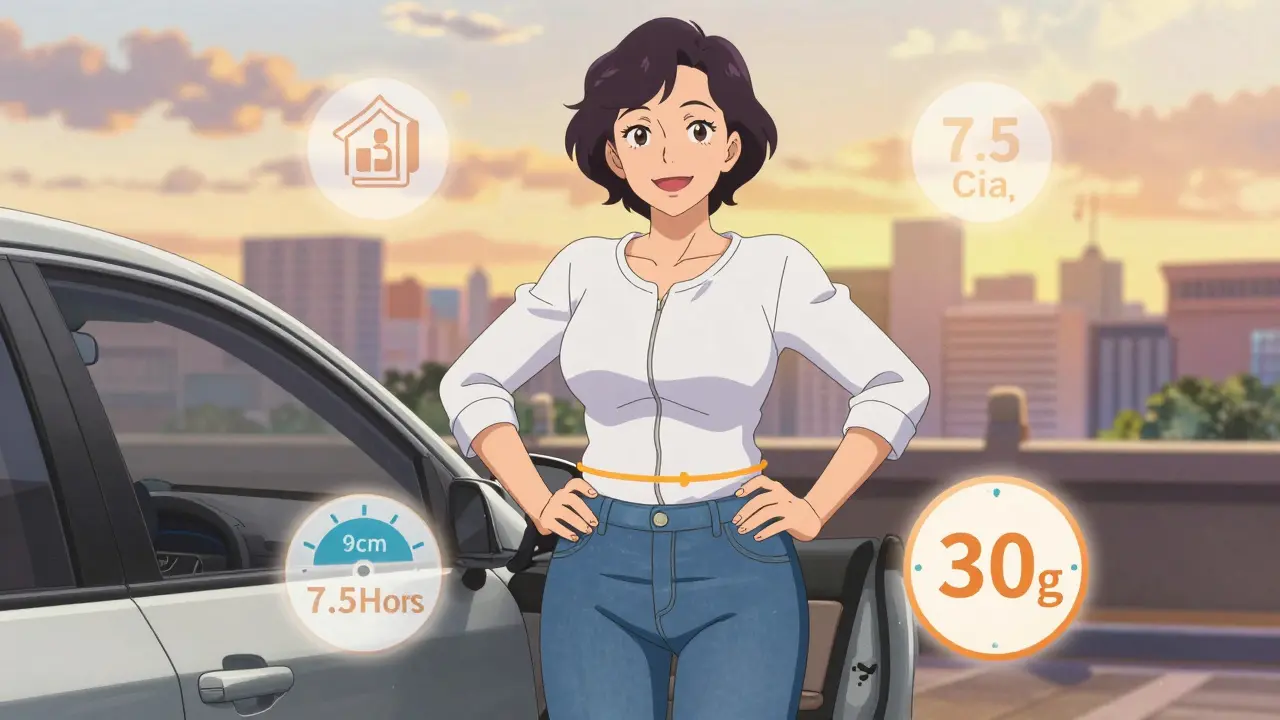
What’s Changing in Medicine
Doctors are starting to take this seriously. The North American Menopause Society now recommends measuring waist circumference at every menopause checkup. If it’s over 88 cm (35 inches), you’re at higher risk for heart disease and diabetes. Mayo Clinic launched a new metabolic test in early 2023 that checks 17 hormones and markers to build a custom plan. And the FDA has approved bimagrumab for Phase 3 trials-a drug that increases muscle and reduces fat in just 24 weeks. But here’s the problem: only 17% of primary care doctors feel trained to handle menopause-related weight gain. Insurance rarely covers menopause-specific programs. You might need to be your own advocate. Ask for metabolic testing. Ask about strength training programs. Ask for referrals to dietitians who specialize in midlife women.Real Women, Real Results
On Reddit’s r/menopause community, a user named MidlifeMama wrote: “I’ve kept the same diet and exercise for 20 years. Since menopause, I gained 25 pounds in three years. My jeans won’t zip.” She’s not alone. In a Mayo Clinic survey, 78% of women said they gained weight despite unchanged habits. But change is possible. One woman in Sydney, 52, started lifting weights three times a week, ate 30g of protein at breakfast, and slept 7.5 hours a night. In six months, she lost 9 cm off her waist. She didn’t lose weight on the scale-but her body changed. She feels stronger. She sleeps better. Her blood pressure dropped. That’s the win.What to Do Next
Start small. Pick one thing:- Do 10 minutes of bodyweight squats and push-ups three times this week.
- Add one high-protein meal to your day-try eggs or tofu at breakfast.
- Turn off screens one hour before bed.
Why am I gaining weight in my belly during menopause even if I eat the same?
Estrogen levels drop sharply during menopause, which shifts fat storage from your hips and thighs to your abdomen. This fat is visceral-surrounding your organs-and is more metabolically active. Even if your calorie intake hasn’t changed, your metabolism slows by 2-3% per decade after 30, and muscle loss accelerates. Hormonal changes also reduce leptin (fullness hormone) and increase ghrelin (hunger hormone), making you feel hungrier without realizing it.
Can hormone replacement therapy (HRT) help with menopause weight gain?
Some studies suggest early HRT, started close to menopause, may help prevent the shift to abdominal fat by stabilizing estrogen levels. However, HRT isn’t a weight-loss treatment. It’s not recommended solely for weight management. The benefits and risks vary by individual-especially for those with a history of breast cancer, blood clots, or heart disease. Talk to a menopause specialist before considering it.
Is cardio enough to lose weight after menopause?
No. Cardio helps burn calories, but it doesn’t stop muscle loss-which is the main reason your metabolism slows. Without strength training, you’ll lose muscle along with fat, making it harder to keep weight off. The most effective approach combines resistance training 2-3 times a week with moderate cardio. Research shows this combo reduces abdominal fat by 8-12% in six months while preserving or building muscle.
How much protein should I eat daily after menopause?
Aim for 1.2 to 1.6 grams of protein per kilogram of body weight. For a 70kg (154lb) woman, that’s 84-112 grams per day. Spread it across meals-25-30 grams per meal-to overcome age-related anabolic resistance. Good sources: eggs, lean meat, fish, tofu, Greek yogurt, lentils, and protein shakes if needed. Most women get far less than this, which is why muscle loss continues.
Why do I feel hungrier after menopause even when I’m not losing weight?
Lower estrogen reduces leptin, the hormone that signals fullness. At the same time, sleep disruptions from hot flashes raise ghrelin, the hunger hormone. Poor sleep also increases cravings for sugary, high-carb foods. This isn’t weakness-it’s biology. Fixing sleep and eating enough protein at each meal helps reset these signals over time.
Should I track my calories after menopause?
Not necessarily. Tracking calories can be helpful short-term to understand portion sizes, but it often leads to frustration because your metabolism has changed. Instead, focus on food quality: protein, fiber, healthy fats, and whole foods. Prioritize sleep, movement, and stress management. These factors have a bigger impact than counting every calorie. If you’re stuck, try a 3-day food journal to spot patterns-not to restrict, but to observe.
How long does it take to see results from a new weight strategy after menopause?
It takes 3-6 months to notice real changes in body composition. Muscle takes time to build. Fat loss is slower than before. Don’t expect the same speed as in your 20s or 30s. A 20-30% slower weight loss rate is normal. Focus on non-scale victories: clothes fitting better, more energy, stronger lifts, better sleep. Those are the real signs of progress.

12 Comments
kenneth pillet
January 17, 2026i started lifting light weights last year after my 48th bday. no magic. just 15 mins 3x a week. my jeans fit again. protein at breakfast helped too. sleep is king. no fancy stuff needed.
Zoe Brooks
January 19, 2026this is the most real thing i’ve read about menopause. i was so mad at myself for gaining weight until i learned it wasn’t me being lazy. now i do squats while brushing my teeth 😅 and i feel like a warrior. thanks for this.
Kristin Dailey
January 20, 2026stop blaming hormones. just eat less and move more. it’s that simple.
Danny Gray
January 22, 2026you know what’s really happening? The pharmaceutical industry and Big Food conspired to make women feel broken so we’d buy pills, protein shakes, and expensive gym memberships. Hormones? A distraction. The real issue is capitalism exploiting biological change. Wake up.
Stacey Marsengill
January 24, 2026i used to be so confident. now i look in the mirror and feel like a stranger. the weight didn’t just show up-it crept in like a thief. and no one talks about how lonely it feels to outgrow your own body.
rachel bellet
January 24, 2026the metabolic dysregulation observed in postmenopausal women is primarily mediated by estrogen receptor-alpha downregulation in adipose tissue, leading to preferential visceral adiposity and insulin resistance. without addressing the HPA axis dysregulation and myokine suppression, any intervention is merely palliative.
Ryan Otto
January 25, 2026This article reads like a corporate wellness pamphlet disguised as science. The SWAN study? Overfunded and underinterpreted. And bimagrumab? A Phase 3 trial with 17 participants. Don’t be fooled. This isn’t biology-it’s monetized fear.
Max Sinclair
January 27, 2026I appreciate the science here. Honestly, I thought I was failing until I read this. I’m 51, and I started doing resistance bands while watching TV. No gym. No obsession. Just consistency. My waist shrunk 1.5 inches in four months. It’s not about being skinny. It’s about being strong.
Praseetha Pn
January 27, 2026They don’t want you to know this but the government is secretly adding estrogen blockers to tap water to control women’s bodies. That’s why your belly grows. That’s why your sleep is trash. That’s why your doctor won’t talk about it. Check your water filter. Check your food. This isn’t biology-it’s control. And they’re winning.
Robert Cassidy
January 27, 2026America’s obsession with ‘fitness’ is a cult. Women are told to lift weights like it’s a moral duty. But what about the women who work two jobs, care for aging parents, and still can’t afford a gym? This article ignores class. It’s not about willpower. It’s about systems. And systems are rigged.
Andrew Qu
January 28, 2026if you're reading this and feeling overwhelmed-start with one thing. one meal with protein. one walk around the block. one night without screens. you don’t need to fix everything today. just show up. your body remembers every small act of care.
Aysha Siera
January 30, 2026they’re putting fluoride in the water to make us gain weight so we’ll take more meds. the same people who sell you protein powder are the ones who run the FDA. you think this is about health? no. it’s about profit. and your belly is the battlefield.