SSRI Sexual Function Tracker
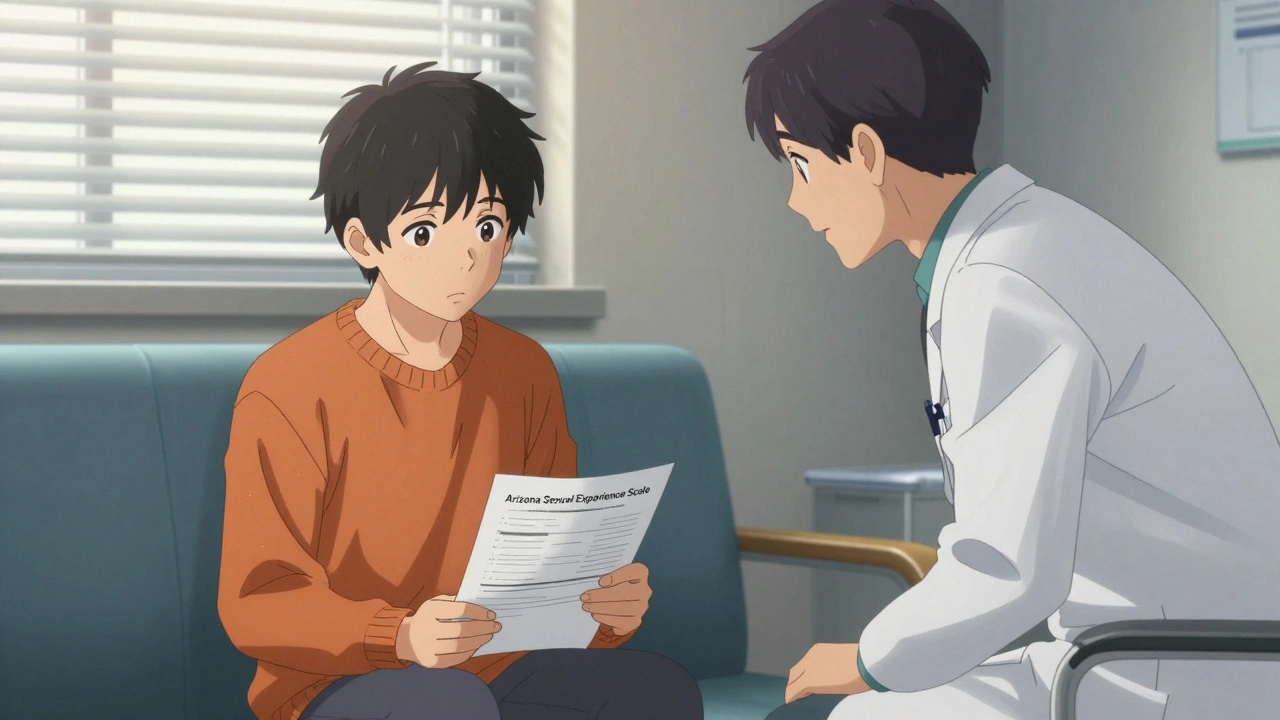
Track your sexual function scores over time to identify patterns and discuss options with your healthcare provider. Based on the Arizona Sexual Experience Scale (ASEX).
Desire
Arousal
Orgasm
Satisfaction
For most patients, symptoms improve within 2-4 weeks of adjusting treatment. If scores consistently fall below 3, discuss these options with your doctor:
- Dose reduction (25-50%)
- Adding bupropion (Wellbutrin)
- Switching to mirtazapine or bupropion alone
Your Tracking History
| Date | Desire | Arousal | Orgasm | Satisfaction | Severity |
|---|---|---|---|---|---|
| No data recorded yet |
Sexual side effects from SSRIs aren’t rare-they’re common. If you’re taking an SSRI like sertraline, fluoxetine, or paroxetine for depression, and you’ve noticed a drop in desire, trouble reaching orgasm, or trouble getting or keeping an erection, you’re not alone. Between 35% and 70% of people on these medications experience some form of sexual dysfunction. What’s worse? Many doctors never bring it up. A Harvard Health poll found 73% of patients said their provider never discussed these risks before prescribing SSRIs. That leaves people feeling confused, embarrassed, or even guilty-like something’s wrong with them, not the medication.
Why SSRIs Cause Sexual Problems
SSRIs work by increasing serotonin in the brain. That helps lift mood. But serotonin also plays a role in sexual response. Too much of it can slow down arousal, dampen pleasure, and delay or block orgasm. The effect isn’t random. It usually shows up within the first 2 to 4 weeks of starting the drug. For some, it’s mild-a little less interest in sex. For others, it’s severe: no orgasm for months, even years. And here’s the twist: up to half of people with depression already have sexual issues before starting SSRIs. So it’s not always clear if the problem is the illness or the treatment. That’s why tracking symptoms matters.
First Step: Talk About It
Before making any changes, you need to know what you’re dealing with. Use a simple tool like the Arizona Sexual Experience Scale or the Antidepressant Sexual Dysfunction Inventory. These aren’t fancy tests-they’re questionnaires that ask about desire, arousal, orgasm, and satisfaction. Rate each on a scale from 1 to 5. Do this before starting the SSRI, then again at 4 weeks and 8 weeks. That gives your doctor real data, not just vague complaints. If you’re not being asked these questions, ask them yourself. Say: “I’m having trouble with sex since starting this med. Can we track it?” Most psychiatrists now screen for this, but not all do. Don’t wait for them to bring it up.
Dose Reduction: Less Drug, Less Side Effect?
One of the simplest fixes is lowering the dose. For mild to moderate depression, cutting the SSRI dose by 25% to 50% often improves sexual function without losing antidepressant benefits. A 2023 study showed 40% to 60% of patients saw better sexual outcomes after reducing their dose. This works best with sertraline, escitalopram, and citalopram. It’s less reliable with fluoxetine because it sticks around in your system for weeks. Don’t just stop taking half a pill on your own. Talk to your doctor. They can help you taper safely. Some people do a “weekend drug holiday”-skip the pill Friday and Saturday, take it Sunday night. That can help if you’re on a short-acting SSRI. But avoid this with fluoxetine. Its half-life is over two weeks. Skipping doses won’t clear it fast enough to help.
Switching Antidepressants: A New Drug, New Effects
If dose changes don’t help, switching meds is the next step. Not all SSRIs are equal when it comes to sexual side effects. Paroxetine is the worst offender. Fluoxetine and sertraline are better. But the real game-changer is switching to a non-SSRI. Bupropion (Wellbutrin) doesn’t boost serotonin-it boosts dopamine and norepinephrine. That means less sexual suppression. Studies show 60% to 70% of people who switch from an SSRI to bupropion see big improvements in desire and orgasm. The catch? It can take 2 to 4 weeks to work. And if you have severe depression, switching increases your relapse risk to 25% to 30%. That’s higher than staying on the SSRI. Mirtazapine and nefazodone are other options. They block certain serotonin receptors and improve sexual function in about half of users. But they make you sleepy. If you’re already tired from depression, that might not help.

Adding Bupropion: The Most Proven Adjunct
You don’t have to quit your SSRI to fix the problem. You can add bupropion on top. This is the most studied and effective strategy. In a double-blind trial with 55 people on SSRIs, adding bupropion 150mg twice daily improved sexual desire and frequency. The improvement was statistically significant. Daily dosing worked better than taking it only before sex. Daily: 66% improvement. As-needed: 38%. That’s a big gap. But there’s a risk. Bupropion can increase anxiety, especially when combined with fluoxetine. One Reddit user said, “Bupropion with fluoxetine gave me panic attacks within 48 hours.” That’s rare, but real. Start low-75mg daily for 3 days, then go to 75mg twice daily. Wait 2 to 4 weeks. If you feel jittery or anxious, talk to your doctor. Don’t push through it.
Other Adjuncts: What Else Works?
Bupropion isn’t the only option. Buspirone (Buspar), a mild anti-anxiety drug, helps about 50% of people with SSRI-related sexual dysfunction. It’s a serotonin modulator, not a stimulant. It takes 2 to 3 weeks to work, but side effects are mild-mostly dizziness. Cyproheptadine, an old antihistamine, blocks serotonin and helps about half of users. But it causes drowsiness in 35% to 40% of people. Dopaminergic drugs like ropinirole or amantadine can help too. They work faster-within 48 hours. But they can cause tremors or anxiety, especially with fluoxetine. They’re not first-line. Use them only if other options fail.
Behavioral Fixes: Sex Isn’t Just About Chemistry
Medication isn’t the only answer. Some people find that changing how they have sex helps. Dr. Levine, a psychiatrist cited in Psychiatry Advisor, says most people under 60 don’t lose orgasm completely-they just feel it’s “dampened.” The fix? Turn up the stimulation. Try new positions, use toys, focus on sensation, or schedule time for intimacy without pressure. Couples who used “sensate focus” exercises-touching without goal, just to reconnect-saw 50% improvement in satisfaction, even while staying on SSRIs. One Reddit user, u/SexTherapistAmy, says: “Couples who stopped chasing orgasm and started exploring touch reported better connection and more pleasure.” It’s not magic. It’s rewiring your brain to associate sex with pleasure again, not pressure.

Persistent Sexual Dysfunction: The Scary Unknown
There’s a growing concern: what if the problem doesn’t go away after you stop the SSRI? The Therapeutic Goods Administration (TGA) in Australia issued a warning in June 2023 about cases where sexual dysfunction lasted for months-or even years-after stopping SSRIs. Some reports go back 16 years of use. That’s rare, but it’s real. The FDA is reviewing whether to add stronger warnings. But here’s the catch: a 2023 systematic review by Tarchi et al. found only 8 solid studies out of hundreds. We don’t yet know how common it is. If you’ve been on SSRIs for a long time and stop them, and your sex life doesn’t bounce back, don’t assume it’s all in your head. Talk to a specialist. There are clinics now that focus on this. The Sexual Health Network lists over 1,200 providers trained in this issue.
What Doesn’t Work
Don’t waste time on unproven fixes. Viagra and Cialis don’t help with low desire or anorgasmia-they only help with erections. And even then, they don’t fix the brain’s dampened pleasure response. Herbal supplements like maca or ginseng? No solid evidence. And never stop your SSRI cold turkey. That can trigger withdrawal: dizziness, nausea, brain zaps, anxiety. Always taper under medical supervision.
What to Do Next
Here’s a simple plan:
- Track your symptoms using a simple scale (desire, arousal, orgasm, satisfaction) before and after starting the SSRI.
- If problems start, talk to your doctor. Ask: “Can we try lowering the dose?”
- If that doesn’t help after 4 weeks, ask about adding bupropion 75mg daily, then titrating up.
- If you’re not improving, ask about switching to mirtazapine or bupropion alone.
- Consider behavioral strategies: scheduled intimacy, sensate focus, reducing performance pressure.
- If symptoms persist after stopping SSRIs, seek a specialist in sexual medicine.
Remember: your depression matters. Your sex life matters. You don’t have to choose one over the other. With the right approach, you can manage both.
Can I just stop my SSRI if sexual side effects are bad?
No. Stopping SSRIs suddenly can cause withdrawal symptoms like dizziness, nausea, brain zaps, and anxiety. Always work with your doctor to taper off slowly. If side effects are unbearable, ask about switching to a different medication instead of quitting cold turkey.
Does bupropion help with low libido from SSRIs?
Yes. Bupropion is the most effective adjunct for SSRI-induced low libido. Daily dosing of 150mg twice daily improved sexual desire and frequency in 66% of patients in a controlled trial. As-needed use (75mg before sex) helped 38%. The key is consistency-daily use works better than occasional use.
Why does fluoxetine make sexual side effects worse?
Fluoxetine has a very long half-life-over 14 days. That means it stays in your system for weeks. This makes it harder to use strategies like drug holidays or quick dose changes. It also builds up slowly, so side effects may not appear until after several weeks, making it harder to link them to the drug. For these reasons, fluoxetine is often avoided when sexual side effects are a major concern.
How long does it take for sexual function to return after stopping SSRIs?
For most people, sexual function returns within a few weeks after stopping. But for some, symptoms persist for months or even years. This is rare but documented. If you’ve been off SSRIs for more than 3 months and still have issues, see a specialist. There are now clinics focused on persistent sexual dysfunction after antidepressant use.
Are there newer antidepressants with fewer sexual side effects?
Yes. Vilazodone (Viibryd) and vortioxetine (Trintellix) were designed to have lower rates of sexual side effects-about 25% to 30% lower than traditional SSRIs. But they’re expensive. Generic sertraline costs about $10 a month; vilazodone can cost $450. Insurance often doesn’t cover them unless you’ve tried cheaper options first.
Can therapy help with SSRI-related sexual problems?
Yes. Sex therapy, especially cognitive behavioral therapy (CBT) and sensate focus exercises, helps people reconnect with pleasure without pressure. Couples who practiced non-goal-oriented touch reported 50% improvement in satisfaction-even while staying on SSRIs. Therapy doesn’t replace medication changes, but it complements them.
Final Thoughts
SSRI sexual dysfunction is treatable. It’s not a personal failure. It’s a known side effect of a powerful class of drugs. You don’t have to suffer in silence. You don’t have to choose between feeling better mentally and feeling connected sexually. With the right steps-tracking symptoms, adjusting dose, adding bupropion, or switching meds-you can fix this. And if it lingers after stopping? You’re not alone. Help exists. You just have to ask for it.
9 Comments
Richard Eite
December 9, 2025This is why America needs to stop letting pharma write our prescriptions
They don't care if you can't cum they care if you keep buying pills
Wake up
Iris Carmen
December 11, 2025i just stopped taking mine and now i feel like a whole new person
like i forgot what it felt like to want sex lol
Shubham Mathur
December 12, 2025Let me tell you something important - this isn’t just about pills or doses, it’s about your dignity
Too many doctors treat this like a side note, like your sex life is optional
But it’s not - it’s part of being human
Track your symptoms, demand data, don’t let anyone gaslight you into thinking it’s all in your head
And if your doctor brushes you off, find a new one - your pleasure matters more than their convenience
Ronald Ezamaru
December 14, 2025I’ve been on sertraline for 5 years and switched to bupropion add-on after 18 months of no orgasm
It took 6 weeks but now I’m back to normal
Key is consistency - daily 75mg twice, not just before sex
Also, avoid fluoxetine entirely - it’s like pouring concrete into your nervous system
Raja Herbal
December 15, 2025Oh so now we’re blaming the pharma giants again
Meanwhile in India, people take SSRIs without even knowing what they are
And still manage to have kids and marriages
Maybe the real issue is we’ve turned sex into a performance metric
om guru
December 16, 2025The science is clear
Track symptoms before and after
Use validated scales
Do not self adjust
Consult a qualified psychiatrist
Sexual function is recoverable
But only with discipline and evidence
Rich Paul
December 18, 2025bupropion lit my libido on fire but also made me feel like a caffeinated raccoon
also fluoxetine is the devil's elixir bro
its half life is longer than my last relationship
Ryan Brady
December 19, 2025I tried everything - dose cuts, bupropion, even that weird antihistamine cyproheptadine
Nothing worked
Then I just started having sex without thinking about it
Turns out I didn’t need a pill
I needed to stop treating my dick like a broken machine
Stacy Tolbert
December 19, 2025I cried when I finally orgasmed again after 11 months
It wasn’t the meds or the dose
It was when my partner held me and said ‘I love you even if you don’t come’
That’s the real treatment
Not a pill
Not a study
Just someone who sees you