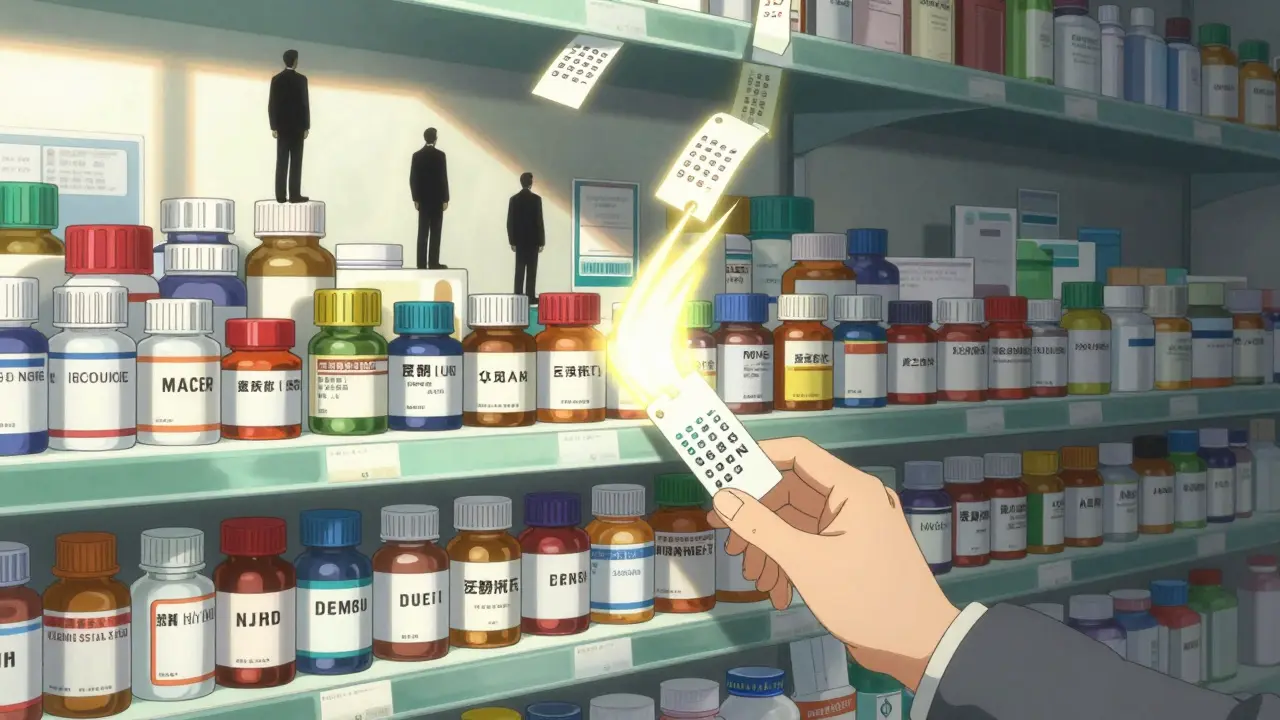
When a brand-name drug’s patent runs out, something predictable happens: other companies start making the same medicine at a fraction of the cost. It’s not magic. It’s competition. And it’s the reason millions of people in the U.S. can afford their prescriptions today. If you’ve ever picked up a bottle of metformin for under $10, or a generic version of Lipitor for less than $5 a month, you’re seeing the direct result of multiple generic manufacturers fighting for market share.
Why More Manufacturers Mean Lower Prices
It’s basic economics: when more companies sell the same thing, they have to lower prices to win customers. This isn’t theory-it’s backed by hard data. A 2021 study in JAMA Network Open looked at 50 brand-name drugs after generics entered the market. The results were clear: the first generic competitor brought prices down by 17%. With two manufacturers, prices dropped 39.5%. Three? 52.5%. And when four or more companies made the drug, prices fell by over 70%.
That’s not a small savings. It’s life-changing for people on fixed incomes. Take levothyroxine, a thyroid medication. A decade ago, one company controlled 90% of the market. Prices climbed steadily. When five other manufacturers entered, the price dropped by 80% in just two years. Patients didn’t need a new prescription. They just got the same pill, cheaper.
The FDA’s Role in Opening the Door
This system didn’t happen by accident. It was designed by Congress in 1984 with the Hatch-Waxman Act. Before that, generic manufacturers couldn’t easily prove their drugs worked the same as brand-name ones. The law changed that. It let them rely on the original drug’s safety data, as long as they showed their version was bioequivalent. That cut approval time from years to months.
The FDA now reviews hundreds of generic applications each year. In 2022 alone, 742 new generic drugs were approved-and they’re projected to save the U.S. healthcare system $14.5 billion annually. The agency makes it clear: more manufacturers = lower prices. Their data shows that even adding one or two more competitors to a market with just one or two can trigger steep price drops.
Where Competition Works-And Where It Doesn’t
Not all drugs behave the same. Oral pills-like antibiotics, blood pressure meds, or diabetes drugs-are the easiest to copy. That’s why they have the most manufacturers and the steepest price drops. A drug like atorvastatin has over 20 makers. You can find it for $4 at Walmart.
But injectables? Infused drugs? Complex generics? Those are different. They’re harder to make. Fewer companies can produce them. And that’s where prices stay high. Take insulin analogs or certain chemotherapy drugs. Even after patents expire, only one or two companies make the generic version. Prices don’t budge. In some cases, they rise.
Biosimilars-generic versions of biologic drugs-are a major exception. Despite being approved for years, their adoption is slow. Medicare data shows that if biosimilars were treated like regular generics, spending on those drugs would be 27% lower. But complicated regulations, manufacturer deals, and pharmacy reluctance keep prices high.
The Hidden Problem: Too Few Competitors
Here’s the scary part: competition is fading. A 2017 study by researchers from MIT, the University of Chicago, and the University of Maryland found that over half of all generic drugs have only one or two manufacturers. That’s not competition-it’s a duopoly. And when one company leaves the market? Prices spike.
Patients on Reddit and Patients Like Me have shared stories of drugs suddenly costing 300-500% more after a manufacturer shut down production. One woman had to switch epilepsy meds because levetiracetam jumped from $15 to $80 a month after three makers exited. She couldn’t afford the brand version. Her doctor had to scramble to find an alternative.
Why is this happening? Mergers. Between 2014 and 2016, nearly 100 small generic companies were bought by larger ones. Now, just a handful of firms control most of the market. The FTC has started challenging some of these deals, but many fly under the radar. The average annual revenue for a generic manufacturer? Around $800,000. That’s not enough to keep small players alive unless they’re bought out.
What This Means for You
If you take a generic drug, check how many makers produce it. Use GoodRx or your pharmacy’s price tool. If there are five or more, you’re likely getting the lowest possible price. If there’s only one or two, ask your pharmacist or doctor if there’s a therapeutically equivalent alternative with more competition.
Look up the drug in the FDA’s Orange Book. If it’s rated AB, it’s considered interchangeable with the brand. That means your pharmacist can swap it without asking your doctor. That’s your leverage. Don’t be afraid to ask for the cheapest version.
And if your drug suddenly becomes expensive? It might not be your fault. It could be that the only two makers had a falling-out, or one went out of business. Report it. The FDA tracks shortages. The more people speak up, the faster they respond.

How to Protect Yourself
- Use price comparison tools like GoodRx, SingleCare, or RxSaver. They show real-time prices across 70,000 pharmacies.
- Ask your pharmacist: “Are there other generic versions of this drug?” Sometimes, one maker’s version is cheaper than another’s, even if they’re the same.
- If your insurance denies coverage, ask for a prior authorization. Sometimes, switching to a more competitive generic triggers approval.
- For chronic conditions, ask your doctor about therapeutic substitution. Many states allow pharmacists to swap generics without a new prescription.
- Join patient forums. If others are reporting price spikes or shortages, you’re not alone-and you might find a workaround.
The system works when competition is strong. But when it fades, patients pay the price. The good news? You have more power than you think. Knowing how many makers produce your drug, and where to find the best price, can save you hundreds-or even thousands-each year.
What’s Next for Generic Drugs?
The FDA’s Drug Competition Action Plan and the CREATES Act are trying to fix the broken parts. They’re pushing to stop brand-name companies from blocking generic makers from accessing samples or delaying approvals. The Generic Drug User Fee Amendments (GDUFA) III, running through 2027, aims to speed up reviews and increase transparency.
But the real fix? More small manufacturers. More market entry. More competition. The Congressional Budget Office estimates that generic and biosimilar competition will save Medicare $158 billion by 2031-if the market doesn’t keep consolidating.
Right now, the system is a balancing act. Innovation is protected. Patients get cheaper drugs. But the middle ground-the small manufacturers who make the competition happen-is under pressure. Without action, the savings we’ve come to expect could vanish.
For now, the rule is simple: more makers = lower prices. Less makers = higher risk. Know your drug. Know your options. And never assume the price you’re paying is the lowest it can be.
Why do generic drug prices drop when more companies make them?
When multiple companies produce the same generic drug, they compete for customers by lowering prices. Studies show that the first generic reduces prices by about 17%, two competitors drop it by nearly 40%, and with four or more, prices fall over 70%. This happens because each manufacturer wants to win market share, and the only way to do that is to offer a better price.
Are all generic drugs the same in quality?
Yes, if they’re rated AB by the FDA. That means they’re bioequivalent to the brand-name drug-same active ingredient, same strength, same effect. The FDA requires strict testing before approving any generic. Differences in fillers or coatings don’t affect how the drug works. But if a drug has only one or two makers, quality issues can lead to shortages, which then cause price spikes.
Can I ask my pharmacist to switch to a cheaper generic?
Yes, in most states, pharmacists can substitute a generic version if it’s rated AB by the FDA and your doctor hasn’t said “dispense as written.” You can also ask them to check if another generic version is cheaper. Many pharmacies use automatic substitution systems, but you still have the right to request the lowest-cost option.
Why are some generic drugs still expensive?
Some drugs have only one or two manufacturers because they’re hard to produce-like injectables, complex generics, or biosimilars. Others are expensive because the market has consolidated. If a company buys out its competitors, it can raise prices without fear of losing customers. This is especially common with older, low-margin drugs where profit margins are thin and only a few players remain.
How can I find out how many companies make my generic drug?
Check the FDA’s Orange Book online. Search your drug by name. It lists all approved generic manufacturers and their therapeutic equivalence ratings. You can also ask your pharmacist or use apps like GoodRx, which show which manufacturers supply your pharmacy and their current prices.
What should I do if my generic drug suddenly becomes much more expensive?
First, check if another generic version is available. Ask your pharmacist to switch to a different manufacturer’s version. If that doesn’t help, contact your doctor about a therapeutic alternative. You can also report the price spike to the FDA’s drug shortage database. Many times, these spikes are temporary-caused by a manufacturer shutting down or a supply issue. Reporting it helps regulators track patterns and respond faster.
15 Comments
Jeffrey Frye
December 23, 2025generic prices drop because companies are literally fighting over who gets to sell the same pill. first guy comes in at 20% off, next guy drops to 40%, then someone else hits 60% and suddenly you’re paying $3 for a month’s supply of metformin. it’s not rocket science, it’s capitalism with a pulse.
Andrea Di Candia
December 24, 2025it’s beautiful when you think about it-medicine, a basic human need, becoming affordable because strangers in factories across the world are competing to help you live. no lobbying, no hype, just science and supply and demand working like they’re supposed to. we should celebrate this more.
Pankaj Chaudhary IPS
December 25, 2025In India, we see this every day. A generic version of insulin costs less than $5 a vial, while the brand name is over $100. The system works when there’s competition. But when only one or two companies control the market, it becomes a monopoly disguised as healthcare. We need more manufacturers, not fewer.
Steven Mayer
December 27, 2025the data is statistically significant, but the underlying assumption-that bioequivalence guarantees therapeutic equivalence-is flawed. dissolution profiles vary, excipients differ, and pharmacokinetic variance exists even within ab-rated generics. you’re not getting the same drug, you’re getting a legally compliant approximation.
Charles Barry
December 28, 2025oh sure, let’s pretend this is all about competition. the real reason prices drop? because the big pharma giants *let* them drop. they own half the generic manufacturers now. it’s a cartel with a new logo. they flood the market with cheap generics to kill small players, then raise prices when they’ve bought them all. the FDA? part of the scheme.
Rosemary O'Shea
December 30, 2025how adorable. you think a $4 pill is a win? i’ve seen people on social media crying because their levothyroxine went from $12 to $80 after one manufacturer vanished. this isn’t capitalism-it’s a rigged game where patients are the collateral. and you’re cheering for the house?
Sidra Khan
December 31, 2025lol so now we’re supposed to be grateful for $5 pills? what about the fact that 80% of generics are made in china and india? you think the quality’s the same? i’d rather pay $50 for the brand and know my meds aren’t sitting in a warehouse with mold.
Lu Jelonek
January 1, 2026if you’re on a chronic med, always check the Orange Book. some generics have the same active ingredient but different fillers that can affect absorption in sensitive patients. ask your pharmacist for the manufacturer name-sometimes the same drug from two different companies behaves differently. it’s not about price, it’s about consistency.
Ademola Madehin
January 2, 2026bro, i had to switch my blood pressure med because the generic i was on went from $10 to $120 overnight. no warning, no notice. just poof. my grandma’s heart was in danger because some corporate suit decided to shut down a factory. this ain’t free market, this is a crime.
suhani mathur
January 3, 2026you people act like this is some miracle of capitalism. in india, generics are so cheap because labor is exploited, factories cut corners, and the government turns a blind eye. sure, you get $3 pills-but at what cost? someone’s health is always the bargain.
Joseph Manuel
January 3, 2026the 70% price reduction cited in the JAMA study is an aggregate metric and does not account for regional pricing variations, pharmacy benefit manager rebates, or the impact of formulary restrictions. the actual out-of-pocket savings for the average patient are often negligible due to insurance structure and tiered copays.
Harsh Khandelwal
January 5, 2026the whole system’s a joke. you think the fda’s watching? nah. they approve generics like they’re printing coupons. i heard a guy in Mumbai who made generics for 20 years say they just swap the color of the pill and call it a day. the active ingredient? same. the rest? guesswork. you’re not getting medicine-you’re getting a lottery ticket.
Andy Grace
January 6, 2026i’ve been on a generic statin for years. price went from $15 to $4. i didn’t notice any difference in how i felt. i trust the science. if the fda says it’s equivalent, i believe it. it’s not about brand loyalty-it’s about not going broke.
Gray Dedoiko
January 7, 2026just wanted to say thank you for this post. my mom’s on levothyroxine and we used to pay $70 a month. now we get it for $8. i didn’t realize how much competition mattered until i saw the orange book. i’m going to start checking every med she takes.
Aurora Daisy
January 8, 2026you americans think you’ve got it bad? in the uk, generics are £1.50 a month. we don’t need to Google ‘GoodRx’-we just walk into a pharmacy and get it. this whole ‘price spike’ drama? you made it yourselves by letting the market become a casino.