When a pharmacist hands you a generic pill instead of the brand-name drug your doctor prescribed, it’s not just a cost-saving trick-it’s a clinical decision backed by science, regulation, and careful communication. But here’s the thing: that switch doesn’t happen in a vacuum. It requires a conversation-often quick, sometimes complex-between the pharmacist and the prescriber. And if that conversation doesn’t happen right, it can lead to confusion, non-adherence, or even harm.
Why Pharmacists Even Bother Recommending Generics
Generics aren’t cheaper because they’re weaker. They’re cheaper because they don’t need to repeat the massive clinical trials brand-name drugs go through. The FDA requires generics to have the same active ingredient, strength, dosage form, and route of administration as the original. More importantly, they must be bioequivalent: meaning they deliver the same amount of medicine into your bloodstream at the same rate. The data is clear: 98.7% of approved generics fall within 95%-105% of the brand’s performance in bioequivalence tests. That’s tighter than most manufacturing tolerances for the brand itself. In 2023, 97% of all prescriptions filled in the U.S. were for generics. That’s over $409 billion saved annually. But money isn’t the only win. A 2018 study tracking 12.7 million patients found that when people got generics instead of brand-name drugs for chronic conditions like high blood pressure or diabetes, their medication adherence jumped by 12.4%. That meant 28.6% fewer people stopped taking their meds-and 15.2% fewer ended up in the hospital. So why don’t all prescribers automatically approve substitutions? Because some still worry. A 2023 survey found 37.6% of doctors have doubts about generic efficacy, especially with tricky drugs like inhalers or topical creams. That’s where pharmacists step in-not to override, but to inform.When a Recommendation Isn’t Just a Suggestion
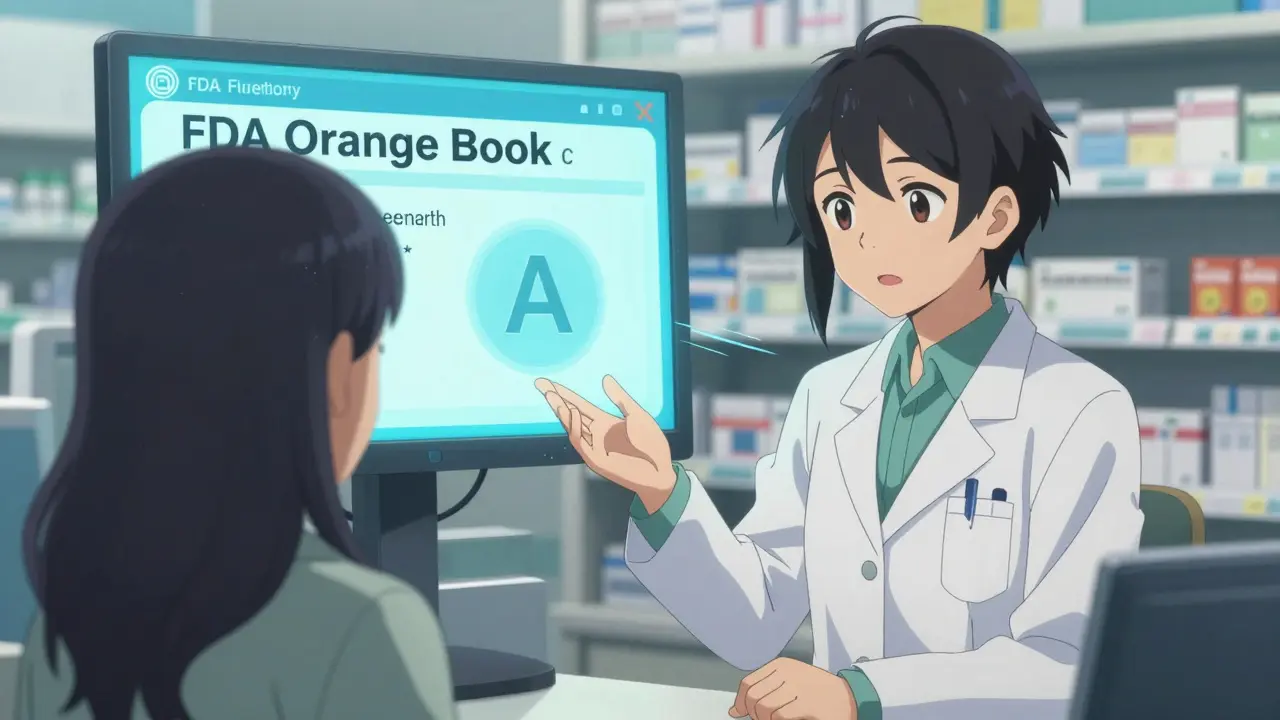
Not every generic can be swapped without a second look. Some drugs live in a narrow therapeutic window-meaning the difference between helping and harming is tiny. These are called narrow therapeutic index (NTI) drugs. Examples include warfarin, levothyroxine, and phenytoin. For these, even small differences in absorption can cause serious side effects. The FDA doesn’t automatically rate all generics for NTI drugs as interchangeable. Only specific products with proven consistency get an “A” rating in the Orange Book. Pharmacists check the Orange Book every time they fill a prescription. It’s the official FDA list of all approved drugs and their therapeutic equivalence ratings. If a generic has an “A” rating, it’s considered interchangeable. If it’s “B,” it’s not. In 2023, 92.7% of generics had an “A” rating. But for NTI drugs, that number drops. Pharmacists don’t just guess-they look it up. And if the prescription says “dispense as written” (DAW), they don’t substitute unless they talk to the prescriber first. And then there’s the hidden issue: inactive ingredients. Generics can have different fillers, dyes, or preservatives. For most people, that’s fine. But for the 8.7% of patients with documented allergies or sensitivities to things like lactose, gluten, or certain dyes, it’s a red flag. A 2021 study in the Journal of Allergy and Clinical Immunology found that 1 in 12 patients had reactions tied to these differences. Pharmacists know this. When they spot a patient with a known allergy, they don’t assume. They call.The Rules Vary by State-And That Matters
In 49 states, pharmacists can substitute a generic unless the prescriber writes “do not substitute” (DNS). But in 17 states, they also need the patient’s consent-written or verbal. Five states-Connecticut, Massachusetts, New York, Texas, and Virginia-go further. They only allow substitution if the generic is on a state-approved formulary. That means even if a generic is FDA-approved, it might not be allowed in those states unless it’s on the list. This isn’t just bureaucracy. It affects real people. About 18% of the U.S. population lives in those five states. A pharmacist in Texas can’t swap a brand for a generic unless it’s on the state’s approved list-even if the FDA says it’s equivalent. So communication isn’t just about safety or savings. It’s about knowing the law.
How Pharmacists Actually Talk to Prescribers
Most of these conversations used to happen over the phone. A pharmacist would call, explain the substitution, and hope the prescriber remembered the details. But that’s outdated. Today, the best tools are built into the electronic health record (EHR) systems. Surescripts’ Generic Drug Substitution module, used by 87% of U.S. prescribers as of 2023, lets pharmacists send a secure message directly into the prescriber’s inbox. The message includes: the brand name, the generic alternative, the Orange Book rating, the cost difference, and a link to the FDA’s Product-Specific Guidance for that drug. The whole thing takes under three minutes. And it’s documented automatically. A 2021 study showed that when pharmacists used this structured approach, prescribers accepted the substitution 82.4% of the time. Without structure-just a quick call-it was only 57.3%. The difference? Evidence. Not opinion. Not guesswork. Data. The American Society of Health-System Pharmacists (ASHP) recommends four steps:- Contact the prescriber within 24 hours of receiving the prescription.
- Cite the Orange Book equivalence rating (A or B).
- Share the cost difference-often 70-90% lower for generics.
- Document the outcome in the patient’s record.
What Gets in the Way
It sounds simple. But time is the enemy. The 2023 National Pharmacist Workload Survey found pharmacists have only 2.3 minutes per prescription to verify, counsel, and communicate. That’s not enough to dig into bioequivalence data for every single drug. Then there’s knowledge gaps. A 2022 study found 41.7% of pharmacists felt unsure about complex generics-like extended-release tablets or transdermal patches. These aren’t just pills. They’re engineered systems. And if the pharmacist isn’t confident, they won’t push. Prescribers, too, are overwhelmed. The 2023 Medscape report showed 62.1% of primary care doctors say they don’t have time to evaluate substitution requests. And 58.3% still worry about therapeutic equivalence-even though the science says otherwise. The fix? Tools. AI-powered platforms like PharmAI’s Generic Substitution Assistant, now used by nearly 30% of chain pharmacies, cut communication time by 42% and boosted recommendation accuracy from 76.4% to 94.2%. These systems pull data from the Orange Book, check patient allergies, flag NTI drugs, and auto-generate messages. Pharmacists review, approve, and send.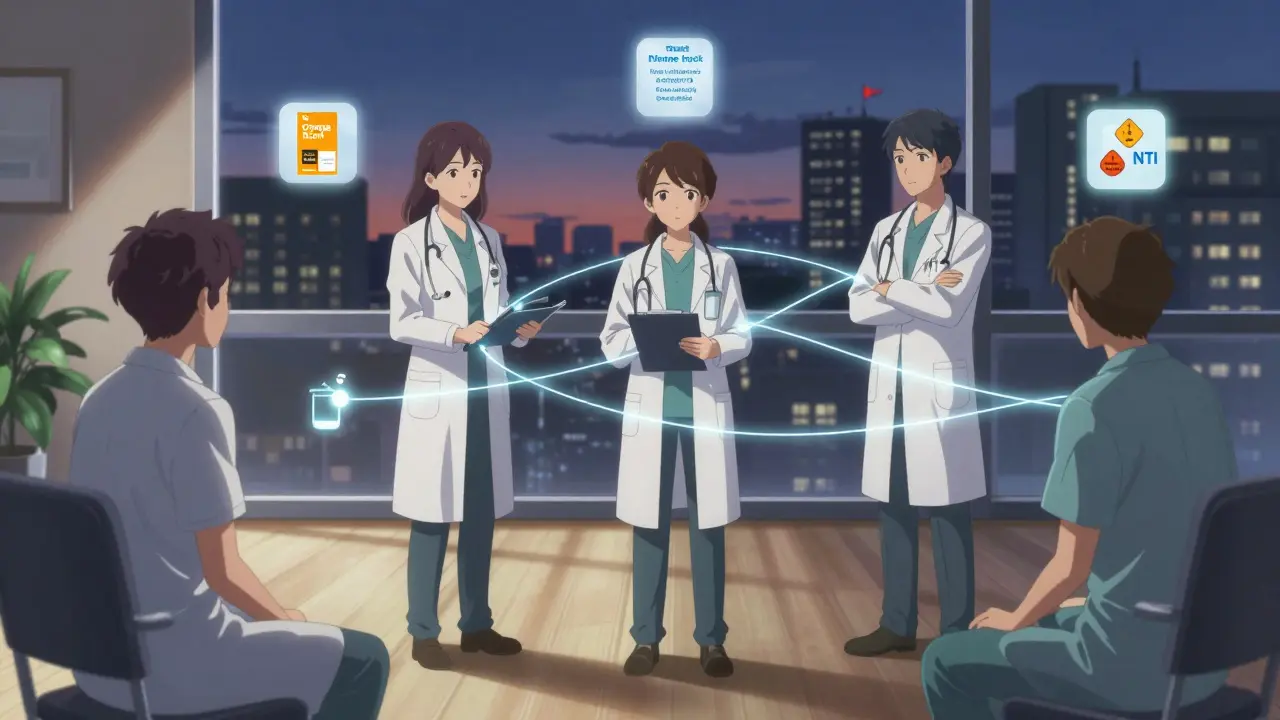
Why Documentation Isn’t Optional
If you don’t document it, it didn’t happen. That’s the rule in every state. The Centers for Medicare & Medicaid Services (CMS) requires pharmacies to record the generic product dispensed, the NDC code, the manufacturer, and any communication with the prescriber. In 2023, pharmacies using EHR-integrated systems hit 98.7% compliance. Those using paper logs? Only 76.4%. The American Medical Association and American Pharmacists Association agree on what to document:- Date and time of communication
- Method used (phone, secure message, etc.)
- Name and credentials of the prescriber contacted
- Specific recommendation made
- Reason for the recommendation
- Outcome: accepted, declined, or pending



9 Comments
Ellie Norris
February 2, 2026Just had a patient cry because her brand-name thyroid med was switched-turns out she’s allergic to the dye in the generic. Pharmacist called the doc, swapped it back, and now she’s got a handwritten note in her file. This stuff matters more than we admit.
Also, why does no one talk about how some generics taste like chalk? I’ve had patients refuse to take them just because of the flavor. Weird, right?
Murarikar Satishwar
February 3, 2026The data’s solid-98.7% bioequivalence, 12.4% better adherence, 15% fewer hospitalizations. But the real win isn’t the cost, it’s the consistency. When people stick to their meds, outcomes improve across the board. That’s not magic, that’s public health.
And yes, the Orange Book is the bible. If you’re not checking it, you’re not doing your job. No excuses. The FDA doesn’t play games, and neither should we.
Vatsal Srivastava
February 4, 2026Most docs are just scared of change and pharmacists act like they’re the new priesthood. Generic = cheaper. That’s it. Stop pretending it’s science when it’s just corporate cost-cutting dressed up as ethics
jay patel
February 5, 2026Oh wow so now pharmacists are the new gatekeepers of medicine? Cool cool. I’m sure the 41.7% who aren’t confident about extended-release formulations are just chilling in the back room sipping coffee while the AI does all the thinking.
Let me guess-next they’ll be prescribing insulin based on a chatbot’s recommendation. ‘Hi, I’m PharmAI, your glucose is 180, so I swapped your Lantus for a generic that’s 70% cheaper. You’re welcome.’
Meanwhile, the patient’s still confused, the doc didn’t get the message, and now the pharmacy’s getting sued because someone’s kidney failed. Oh wait, that already happened in Ohio last year. Forgot to document. Again.
phara don
February 5, 2026Interesting that the EHR integration boosted acceptance to 82.4%-makes me wonder how many prescribers just click ‘approve’ without reading. Are we automating compliance instead of understanding?
Also, what’s the dropout rate on those automated messages? Do any prescribers actually reply? Or is it just a checkbox now?
Dan Pearson
February 5, 2026Let’s be real-this whole thing is a government-backed scam to make Big Pharma look bad. Generics are fine for your grandma’s blood pressure pill, but try giving someone with epilepsy a generic phenytoin and see how fast they end up in the ER. And don’t even get me started on the ‘formulary’ nonsense in Texas. We’re not in some bureaucratic fantasyland here, we’re saving lives.
And who the hell approved letting AI write messages to doctors? Next thing you know, a chatbot will be telling a patient to skip their chemo because ‘the algorithm says it’s not cost-effective.’
clarissa sulio
February 6, 2026Look, if you’re American, you should be proud we’ve got the most advanced pharmacy system in the world. No other country has this level of regulation, data tracking, and pharmacist autonomy. The fact that we’re even talking about this means we’re winning.
Other countries? They just hand out pills and hope for the best. We’ve got Orange Books, EHR integrations, AI assistants, and documentation standards that would make the EU jealous. So stop complaining and appreciate the system that keeps you alive.
larry keenan
February 6, 2026The structural inefficiencies in communication workflows remain under-addressed despite technological advances. The cognitive load on pharmacists, particularly in high-volume settings, is non-trivial and inadequately mitigated by algorithmic nudges.
Furthermore, the implicit assumption that bioequivalence equates to therapeutic equivalence overlooks interindividual pharmacokinetic variability, particularly in polypharmacy cohorts. The 2021 JACI study on excipient sensitivity is underutilized in clinical decision support systems, representing a latent safety risk.
Documentation compliance at 98.7% in EHR-integrated systems is statistically significant (p<0.001), yet the causal mechanisms behind this improvement require further ethnographic inquiry.
Monica Slypig
February 8, 2026Oh so now we're letting pharmacists play doctor? And you call that progress? My cousin's husband took a generic version of his heart med and ended up in the hospital because the fillers were different. You think an algorithm knows what's in someone's body? Nope. Only a real doctor does.
And don't get me started on the 'formulary' nonsense. If you're in Texas and your generic isn't on the list, tough luck. That's not healthcare, that's bureaucratic tyranny.
Meanwhile, the FDA's been asleep at the wheel for years. I bet half those 'A' ratings are just paperwork. This whole system is a house of cards built on corporate greed and lazy medicine.