Steroid Eye Risk Calculator
Calculate Your Risk
Answer these questions to assess your risk of steroid-induced cataracts or glaucoma based on current medical guidelines.
Your Risk Assessment
75%
High Risk
Recommended Actions
Key Risk Factors
When you’re on long-term steroids-whether it’s pills for rheumatoid arthritis, inhalers for asthma, or eye drops for uveitis-you’re not just fighting inflammation. You’re also putting your eyes at risk. Two serious, often silent conditions can develop: steroid-induced cataracts and steroid-induced glaucoma. These aren’t rare side effects. They’re common, preventable, and often missed until vision is already damaged.
How Steroids Damage Your Eyes
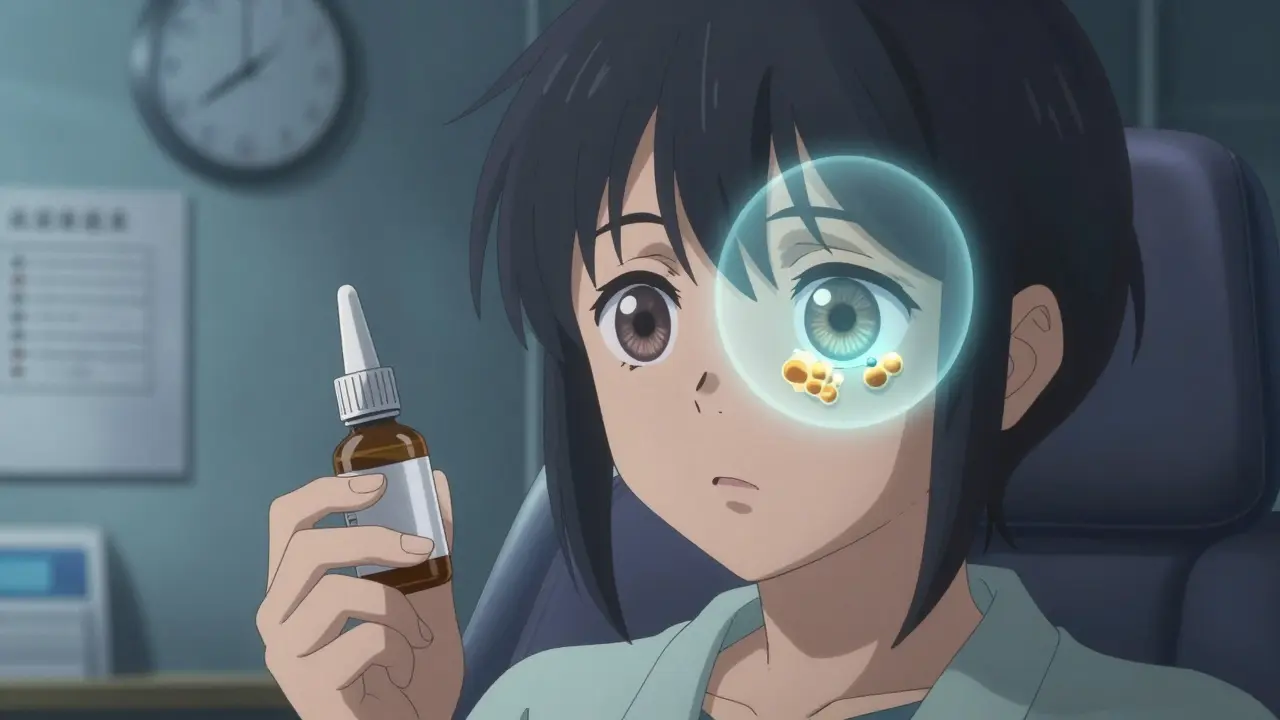
Corticosteroids work by calming your immune system. That’s great if you have severe eczema, lupus, or an inflamed eye. But your eyes don’t respond to steroids the same way your skin or lungs do. In the eye, steroids trigger chemical changes that directly affect the lens and drainage system. For cataracts, the problem starts with the lens. Steroids interact with proteins in the lens, forming abnormal clusters called Schiff base adducts. These aren’t found in normal aging cataracts. They cause a specific type called posterior subcapsular cataracts-cloudy patches that form right behind the lens, right where light focuses. This isn’t a slow blur. It can turn your vision hazy in just weeks. People report seeing halos around lights, colors looking washed out, and trouble driving at night-all before they realize something’s wrong. Glaucoma works differently. Your eye has a drainage system that keeps pressure balanced. Steroids clog that system, like pouring syrup into a drain. Fluid builds up, pressure rises, and over time, that pressure crushes the optic nerve. Unlike regular glaucoma, which creeps in silently over years, steroid-induced glaucoma can spike pressure in as little as two weeks. And here’s the scary part: you won’t feel it. No pain. No redness. Just gradual loss of side vision-until it’s too late.Who’s at Risk?
Not everyone who uses steroids gets eye damage. But some people are far more vulnerable. About 30% to 40% of the general population are ‘steroid responders’-meaning their eye pressure rises noticeably after exposure. Among people with a family history of glaucoma, that number jumps to over 90%. If you’ve already been diagnosed with glaucoma, you’re at extreme risk. One study found nearly all glaucoma patients develop dangerous pressure spikes with steroid use. Age matters too. Younger people on long-term steroids are more likely to develop steroid cataracts than older adults. That’s because age-related cataracts are common after 60, so doctors often miss the steroid-driven ones. But if you’re 35 and suddenly need cataract surgery, steroid use should be the first thing your eye doctor checks. The route of delivery changes the risk. Topical eye drops are the worst offenders. A single bottle of steroid eye drops used daily for four months can cause cataracts or glaucoma in someone who never had eye problems before. Oral steroids like prednisone take longer to cause damage-usually months-but the risk is still real. Even nasal sprays and inhalers can raise eye pressure if used heavily over time.What the Numbers Don’t Tell You
Studies say steroid-induced glaucoma affects 5% to 35% of users. That’s a huge range. Why? Because it depends on who you are. If you’re a healthy 50-year-old using a short course of eye drops after cataract surgery, your risk is low. But if you’re a 40-year-old with Crohn’s disease on daily prednisone for five years? Your risk is high. Here’s what the data shows: 66% of people see a small pressure rise-under 5 mmHg. That’s usually harmless. But 30% get a moderate spike-6 to 15 mmHg. That’s where monitoring becomes critical. And 5%? Their pressure jumps over 15 mmHg. That’s an emergency. That kind of spike can destroy your optic nerve in months. And here’s the hidden truth: nearly one-third of steroid-induced glaucoma cases happen in people with no prior eye history. There’s no warning. No family tree of glaucoma. Just a prescription and a slow, silent collapse of vision.
Early Signs You Can’t Ignore
Glaucoma doesn’t hurt. Cataracts don’t always sting. That’s why they’re so dangerous. For cataracts, watch for:- Blurred or cloudy vision that doesn’t improve with glasses
- Seeing halos or glare around lights, especially at night
- Colors looking faded or yellowish
- Needing brighter light to read
- Frequent changes in your eyeglass prescription
- Loss of peripheral vision-like looking through a tunnel
- Difficulty adjusting to dark rooms
- Seeing rainbow-colored rings around lights
- Eye redness or discomfort (though this is rare)
How to Protect Your Vision
The good news? Almost all steroid-related eye damage is preventable-if you act early. 1. Get a baseline eye exam before starting steroids. Your eye doctor should check your intraocular pressure (IOP), examine your optic nerve, and look for early signs of lens changes. This isn’t optional. It’s essential. 2. Schedule follow-ups. The NIH recommends:- Check IOP at two weeks after starting steroids
- Then every 4-6 weeks for the first three months
- Then every six months if pressure stays normal



12 Comments
Sheila Garfield
January 31, 2026My mom was on prednisone for years after her transplant. She never told anyone about the halos she saw at night until her cataract surgery. Now she’s got a new lens and a whole new outlook on life. Don’t ignore the little things - your eyes don’t scream, they just fade.
Shawn Peck
February 1, 2026Look, if you’re on steroids, you’re playing Russian roulette with your eyes. No joke. One guy I know lost 40% of his peripheral vision in 6 months because he thought ‘it’s just eye drops.’ Spoiler: it’s not. Get checked or go blind. Simple.
Eliana Botelho
February 2, 2026Okay but have we considered that maybe the real issue is that doctors are lazy? Like, why do they just hand out steroid eye drops like candy? My cousin got prescribed them for a scratchy eye and ended up with glaucoma. The doctor didn’t even ask if she had family history. It’s not the steroids - it’s the system. They don’t care until you’re already blind. And then they act shocked. 🤷♀️
Darren Gormley
February 3, 202630% of people are ‘steroid responders’? Bro, that’s basically 1 in 3. So if you’re on steroids, you’re basically rolling a die. And the die is loaded. 😅 Also, ‘non-steroid anti-inflammatory’ sounds like a marketing term for ‘something that probably doesn’t work as good but lets the pharma company avoid lawsuits.’
Sidhanth SY
February 4, 2026My uncle in India got steroid drops after a corneal infection. He got checked every month because his doctor there is super strict. No cataracts, no pressure spikes. It’s not about avoiding steroids - it’s about being smart with them. Talk to your doctor. Ask questions. That’s all it takes.
Adarsh Uttral
February 4, 2026lol i used steroid drops for my allergies for 3 months and my eyes felt weird but i thought it was just dry. turns out i had a 12 point pressure spike. no symptoms. just a random checkup saved me. yall need to get your eyes checked even if you feel fine.
Jason Xin
February 5, 2026Interesting how the article mentions home IOP monitors. I’ve got one. Costs $300. Insurance won’t cover it. So now the people who can afford to save their vision are the ones who already have the money. Classic. 😒
Yanaton Whittaker
February 7, 2026AMERICA NEEDS TO STOP GIVING OUT STEROIDS LIKE FREE SAMPLES. This is why our healthcare is broken. In Russia, you need a 3-person committee to get steroid eye drops. We give them to people who sneeze too hard. FIX THE SYSTEM.
Donna Fleetwood
February 8, 2026You’re not alone. I was scared to speak up about my eye changes too - until I realized I was the only one who noticed. Now I tell everyone on steroids to get checked. Your vision is worth it. You got this 💪
Blair Kelly
February 10, 2026Let’s be brutally honest: the pharmaceutical industry profits from both the prescription and the surgery. Steroid-induced glaucoma isn’t an accident - it’s a revenue stream. They market the drug, then sell you the fix. And they call it ‘medical progress.’
Lily Steele
February 10, 2026My sister’s on biologics for psoriasis. Her dermatologist referred her to an ophthalmologist before she even started. No big deal. Just standard care. Why isn’t this normal everywhere? It should be. Simple.
Amy Insalaco
February 12, 2026While the piece offers a clinically relevant framework, it fundamentally underestimates the epistemological dissonance between pharmacodynamic risk stratification and patient-centric behavioral compliance. The 30% responder cohort is not merely a statistical anomaly - it represents a phenotypic vulnerability rooted in glucocorticoid receptor polymorphisms, particularly rs6198 and rs41423247, which are underrepresented in current screening protocols. Moreover, the normalization of ‘low-risk’ topical administration ignores the cumulative bioavailability threshold of ocular tissue, which is nonlinear and dose-sensitized over time. Until we implement genome-guided prophylaxis - not just periodic tonometry - we are merely managing symptoms, not preventing pathology.