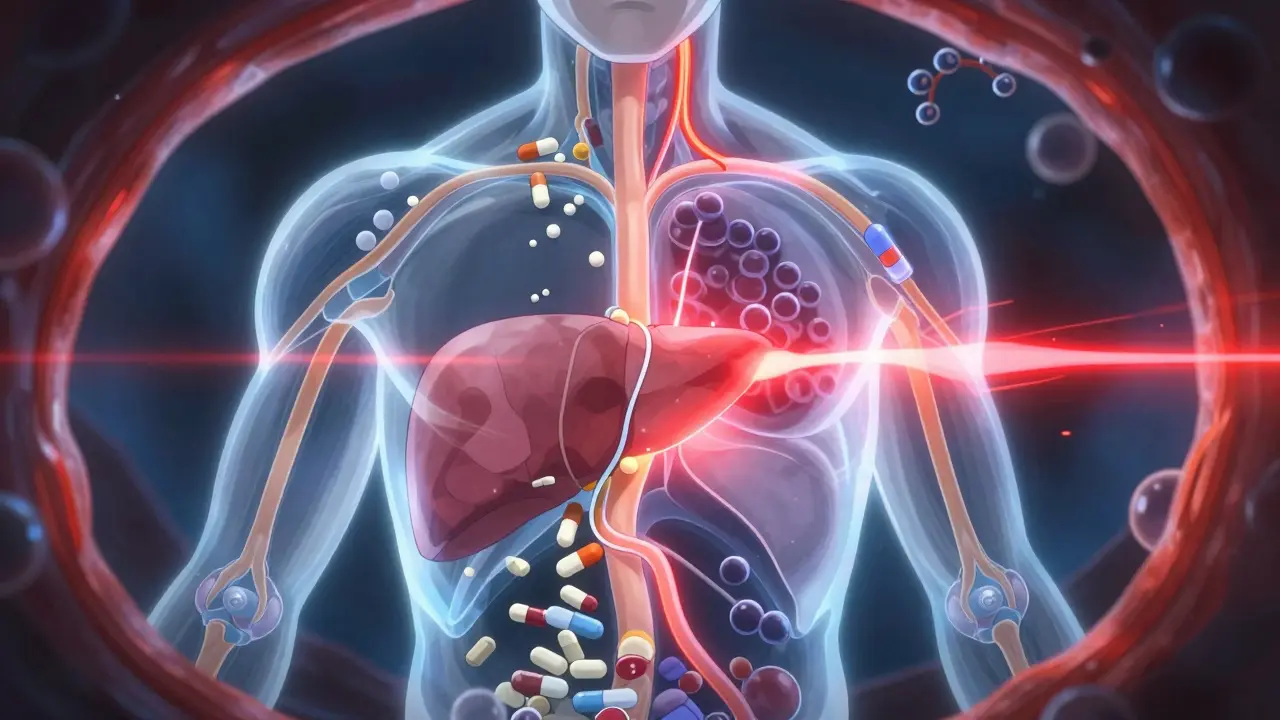
When you take more than one medication, your body doesn’t just process them separately. They talk to each other-sometimes helpfully, sometimes dangerously. Two main types of drug interactions drive these conversations: pharmacokinetic and pharmacodynamic. Understanding the difference isn’t just for doctors and pharmacists. If you’re on five or more meds-especially if you’re over 65-you need to know how they might be working against you.
What pharmacokinetic interactions do to your body
Pharmacokinetic interactions are about what your body does to the drug. Think of it like a delivery system. Your body absorbs, distributes, breaks down, and gets rid of drugs. If one drug messes with any of those steps, the amount of another drug in your bloodstream can spike or drop dangerously. The biggest player here is the liver’s CYP3A4 enzyme. It handles about 75% of all drug metabolism. When you take clarithromycin (an antibiotic) with simvastatin (a cholesterol drug), clarithromycin shuts down CYP3A4. That means simvastatin can’t break down properly. Instead of a safe level, you get up to 10 times more of it in your blood. That’s a recipe for muscle damage or even kidney failure. The FDA recommends cutting simvastatin to just 10mg if you’re on clarithromycin. Other common offenders:- Antacids like Tums can block absorption of antibiotics like ciprofloxacin by up to 90%-so the antibiotic just passes through you unused.
- Warfarin, a blood thinner, can be kicked out of protein binding by drugs like phenylbutazone, sending free warfarin levels soaring by 300%. That’s a huge bleeding risk.
- Probenecid, used for gout, can slow down penicillin clearance by half, making it stick around longer than intended.
These changes don’t happen overnight. If you start a new drug that inhibits an enzyme, it usually takes 3 to 5 days for the full effect to show. That’s why some interactions fly under the radar-they’re delayed.
What pharmacodynamic interactions do to your body
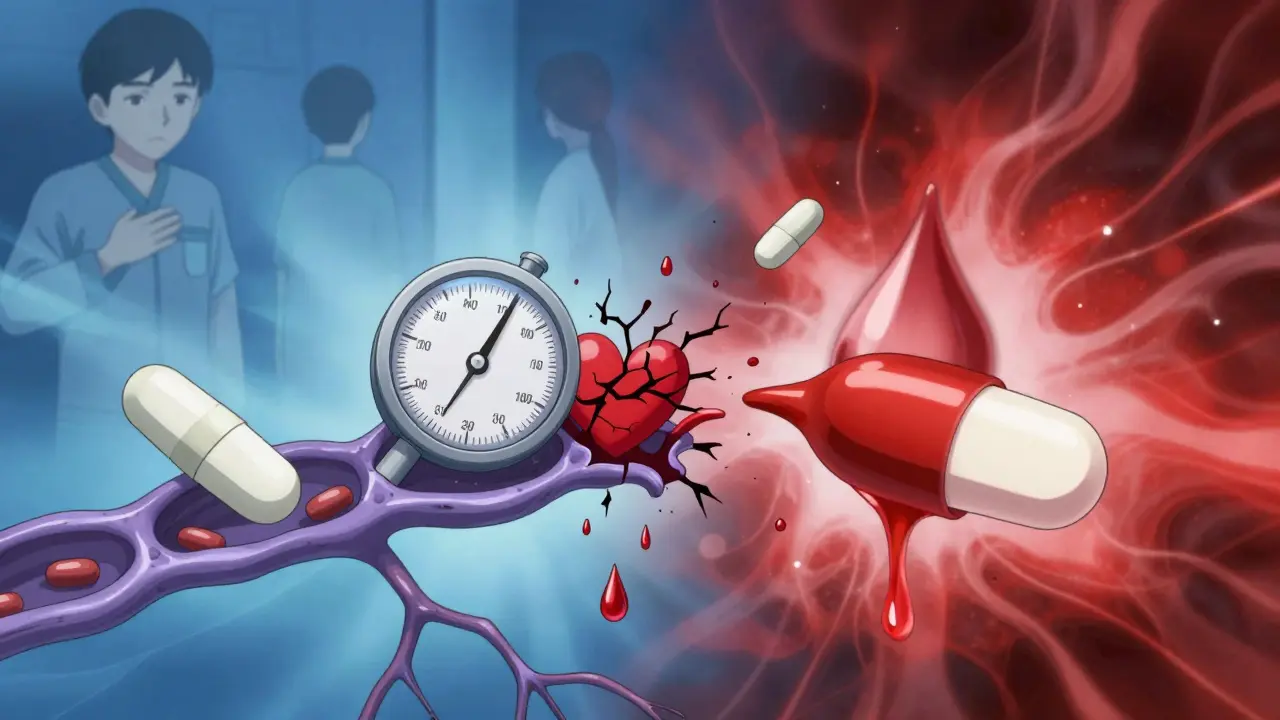
Pharmacodynamic interactions are about what the drug does to your body. Here, drug levels might be perfectly normal-but the combined effect is too strong, too weak, or outright dangerous. There are three kinds:- Synergistic: The combo is stronger than the sum of its parts. Take sildenafil (Viagra) with nitroglycerin. Each lowers blood pressure. Together? They can crash it so hard you go into shock.
- Additive: Effects just add up. Warfarin and aspirin both thin blood. Together, they raise bleeding risk far beyond what either does alone.
- Antagonistic: One drug cancels the other. Naloxone reverses opioid overdoses by kicking opioids off their receptors. Or, NSAIDs like ibuprofen can block the blood pressure-lowering effect of ACE inhibitors by 25-30%.
These are sneakier than pharmacokinetic ones. You can’t measure them with a blood test. You can’t adjust a dose to fix them. The only safe move? Avoid the combo entirely.
That’s why mixing SSRIs with MAO inhibitors is banned. Both increase serotonin. Together? They trigger serotonin syndrome-high fever, seizures, muscle rigidity. It’s rare, but deadly. And you won’t know until it’s too late.
Why the difference matters for your safety
Here’s the key: pharmacokinetic interactions change how much drug is in your blood. Pharmacodynamic interactions change how your body reacts to that drug. That means different fixes:- If it’s pharmacokinetic: Monitor levels. Adjust the dose. Use therapeutic drug monitoring for drugs like warfarin, digoxin, or phenytoin.
- If it’s pharmacodynamic: Stop the combo. No workaround. No dose tweak will save you.
For example, if you’re on digoxin and start taking amiodarone (a heart rhythm drug), the amiodarone slows digoxin clearance. Your digoxin level climbs. Your doctor lowers the digoxin dose-and you’re safe.
But if you’re on a beta-blocker and take a beta-agonist (like albuterol for asthma), they’re fighting over the same receptors. No matter how much you adjust either dose, they’re canceling each other out. The fix? Don’t combine them.
According to data from the UK’s Specialist Pharmacy Service, pharmacokinetic interactions cause nearly half (47%) of serious drug interactions. But pharmacodynamic ones make up 37%-and they’re the leading cause of dangerous reactions in the brain and heart. Over 85% of CNS drug interactions are pharmacodynamic.
Who’s most at risk?
It’s not just the elderly. But they’re the most vulnerable. In the UK, 15% of adults over 65 take five or more medications daily. That’s a perfect storm for interactions. Narrow therapeutic index drugs are especially risky. These are meds where the difference between a helpful dose and a toxic one is tiny:- Warfarin
- Digoxin
- Phenytoin
- Lithium
Two-thirds of serious interactions with these drugs are pharmacokinetic. That’s why your pharmacist checks your list every time you pick up a new prescription.
But don’t think you’re safe just because you’re young. Polypharmacy is creeping into younger populations too-especially people with chronic conditions like diabetes, depression, or autoimmune disease.
How modern tools help (and where they fall short)
Electronic health records now flag hundreds of dangerous combinations. Epic’s system alone detects over 1,200 high-risk pharmacokinetic interactions and nearly 1,000 pharmacodynamic ones. But here’s the catch: alerts are noisy. Doctors get so many warnings they start ignoring them. That’s why pharmacist-led medication reviews cut adverse drug events by 42% in one major study. Pharmacogenomics is also changing the game. If you have a CYP2D6 poor metabolizer gene, even a normal dose of codeine won’t work-and if you’re a fast metabolizer, it can turn into dangerous levels of morphine. The Clinical Pharmacogenetics Implementation Consortium (CPIC) now has 32 gene-drug pairs with clear guidance. New AI models are getting better at predicting pharmacodynamic interactions. One 2023 study hit 89% accuracy-far better than older methods. But AI still can’t replace a clinician who knows your history, your symptoms, and your lifestyle.
What you can do right now
You don’t need to be a scientist to protect yourself. Here’s what works:- Keep a written list of every medication you take-including vitamins, supplements, and over-the-counter drugs.
- Ask your pharmacist: “Could any of these interact?” Don’t wait for them to ask you.
- If you start a new drug and feel weird-dizzy, nauseous, weak, confused-don’t assume it’s normal. Call your doctor or pharmacist immediately.
- Know your high-risk meds. If you’re on warfarin, digoxin, or lithium, get your levels checked regularly.
- Never stop or start a drug without checking. Even herbal supplements like St. John’s Wort can trigger dangerous interactions.
One real case: a 72-year-old woman in Oxford was on warfarin, lisinopril, and ibuprofen for arthritis. Her INR (a blood clotting measure) kept creeping up. No one realized the ibuprofen was boosting warfarin’s effect. Once she switched to paracetamol, her INR stabilized. No hospital visit. No bleed. Just a simple swap.
What’s next?
The FDA and EMA now require drug makers to test interactions with 11 enzymes and 8 transporters-up from just 7 enzymes a few years ago. That’s progress. But the biggest breakthrough might be in awareness. The WHO estimates that better management of these two types of interactions could prevent 1.3 million adverse drug events worldwide by 2030. That’s millions of hospital stays avoided. Billions in savings. It’s not magic. It’s just knowing the difference between a drug that changes your blood levels-and one that changes how your body responds.What’s the difference between pharmacokinetic and pharmacodynamic drug interactions?
Pharmacokinetic interactions affect how your body processes a drug-its absorption, metabolism, distribution, or excretion. This changes the drug’s concentration in your blood. Pharmacodynamic interactions affect how the drug works in your body-like how it binds to receptors or affects your physiology-regardless of blood levels. One changes the dose; the other changes the response.
Can you fix a pharmacokinetic interaction by changing the dose?
Yes, often you can. For example, if a drug slows the metabolism of another, your doctor may lower the dose of the affected drug. Therapeutic drug monitoring (TDM) helps track blood levels to find the right balance. This works well for drugs like warfarin, digoxin, or phenytoin. But it’s not always possible-especially if the interaction is too strong or unpredictable.
Why are pharmacodynamic interactions harder to manage?
Because they don’t show up in blood tests. Even if drug levels are normal, the combined effect can be dangerous-like when two drugs both lower blood pressure too much. You can’t adjust a dose to fix that. The only safe option is usually to avoid the combination entirely. That’s why some drug pairs are outright contraindicated.
Which drugs are most likely to cause serious interactions?
Drugs with a narrow therapeutic index are highest risk-like warfarin, digoxin, lithium, and phenytoin. Also high-risk: antidepressants, antipsychotics, opioids, blood thinners, and heart medications. CYP3A4-metabolized drugs (like statins, some antibiotics, and anti-seizure meds) are common culprits in pharmacokinetic interactions. CNS drugs like SSRIs and benzodiazepines are frequent in pharmacodynamic ones.
Should I worry about supplements and herbal remedies?
Absolutely. St. John’s Wort can reduce the effectiveness of birth control pills, antidepressants, and even some cancer drugs by speeding up their metabolism. Garlic and ginkgo can increase bleeding risk with warfarin. Grapefruit juice can dangerously raise levels of many statins and blood pressure meds. Always tell your pharmacist about everything you take-even if you think it’s "natural" or "harmless."
How often should I review my medications?
At least once a year-or every time you start or stop a medication. If you’re on five or more drugs, or if you’re over 65, ask for a medication review with your pharmacist. Many NHS pharmacies offer this for free. It takes 20 minutes and can prevent a hospital visit.
Can electronic health records catch all dangerous interactions?
No. Systems like Epic flag over 2,200 high-risk interactions, but they miss many, especially pharmacodynamic ones. They also generate too many false alarms, leading to alert fatigue. That’s why human review by a pharmacist is still the gold standard. Technology helps-but it doesn’t replace clinical judgment.
14 Comments
Teresa Marzo Lostalé
December 29, 2025I used to think meds were just pills you swallow and hope for the best. Then my grandma ended up in the ER because she took that herbal tea with her blood thinner. Now I keep a little notebook. 🙃
It’s wild how something so simple can turn into a disaster if you don’t ask the right questions.
ANA MARIE VALENZUELA
December 30, 2025People still don’t get it. You don’t just ‘take a little ibuprofen’ if you’re on warfarin. It’s not a snack. It’s a slow-motion suicide attempt waiting to happen. Stop being lazy and talk to your pharmacist.
Bradly Draper
January 1, 2026I didn’t know all this stuff. My dad’s on like 7 meds and I just thought he was being dramatic when he said he felt weird after a new prescription. Now I’m gonna sit down with him and go through his list. Thanks for the wake-up call.
Gran Badshah
January 1, 2026In India we just take whatever the doctor gives us and shut up. But after reading this, I’m gonna ask my uncle why he’s mixing turmeric with his heart pills. He says it’s ‘natural’-but natural doesn’t mean safe.
Ellen-Cathryn Nash
January 3, 2026I’ve seen too many people treat their meds like candy. It’s not a game. You’re not a superhero. You’re just one bad combo away from a coma. And then you wonder why the system is broken. Well, maybe it’s because people refuse to take responsibility.
St. John’s Wort? Really? You think your ‘wellness journey’ is more important than your liver?
Samantha Hobbs
January 4, 2026OMG I JUST REALIZED I’VE BEEN TAKING GINKGO WITH MY BLOOD THINNER FOR 3 YEARS. I’M SO SCARED RIGHT NOW. I’M CALLING MY PHARMACIST RIGHT NOW. THANK YOU FOR THIS POST!!
Nicole Beasley
January 5, 2026I didn’t know pharmacodynamic meant the drugs were fighting inside me 😳 Like, imagine two kids wrestling over one toy and the whole house catches fire. That’s my body rn.
sonam gupta
January 6, 2026America overcomplicates everything. In India we take pills and pray. No lists. No apps. No 1000 alerts. We live longer than you anyway. Your system is broken because you fear medicine not trust it.
Julius Hader
January 6, 2026I’ve been on lithium for 12 years. Every time I get a new script, my pharmacist gives me the side-eye like I’m a walking bomb. And honestly? She’s right. I don’t mess around with NSAIDs anymore. Not worth it.
It’s scary how one little OTC painkiller can turn your life upside down.
Vu L
January 7, 2026This post is so overblown. Most people don’t even take 5 meds. And yeah, sure, some interactions are bad. But you’re acting like every combo is a death sentence. I’ve been on statins and antibiotics for years. Still breathing. Chill out.
James Hilton
January 8, 2026So let me get this straight - we spend billions on AI to predict drug interactions... but the solution is still ‘don’t mix stuff’ and ‘ask your pharmacist’?
Wow. We invented the smartphone but still need a human with a clipboard to keep us alive. Progress.
Mimi Bos
January 9, 2026i just reaald this and i think i might have mixed grapefruit with my blood pressure med… i hope i didnt kill myself. also i think i spelled ‘med’ wrong. oops 😅
Payton Daily
January 10, 2026You know what this really is? A metaphor for life. We’re all just chemicals floating in a body, trying to find balance. One wrong molecule, one bad choice, and the whole system collapses. We think we’re in control - but really, we’re just passengers in a machine we barely understand.
That’s why I meditate now. Not because it’s trendy. Because if my brain can’t handle my own thoughts, how am I supposed to handle my meds?
And don’t get me started on the patriarchy’s role in medical paternalism. Why do we let doctors decide what goes in our bodies? We’re not children. We’re sovereign beings. But also... maybe we shouldn’t take St. John’s Wort with SSRIs. Just saying.
Kelsey Youmans
January 11, 2026This is an exceptionally well-structured and clinically accurate exposition on the distinction between pharmacokinetic and pharmacodynamic interactions. The inclusion of therapeutic drug monitoring as a mitigation strategy for the former, and the unequivocal contraindication of the latter, aligns precisely with current guidelines from the American College of Clinical Pharmacy. I commend the author for emphasizing the indispensable role of pharmacist-led reviews, which remain underutilized despite robust evidence demonstrating their efficacy in reducing adverse drug events. This should be required reading for all patients on polypharmacy regimens.