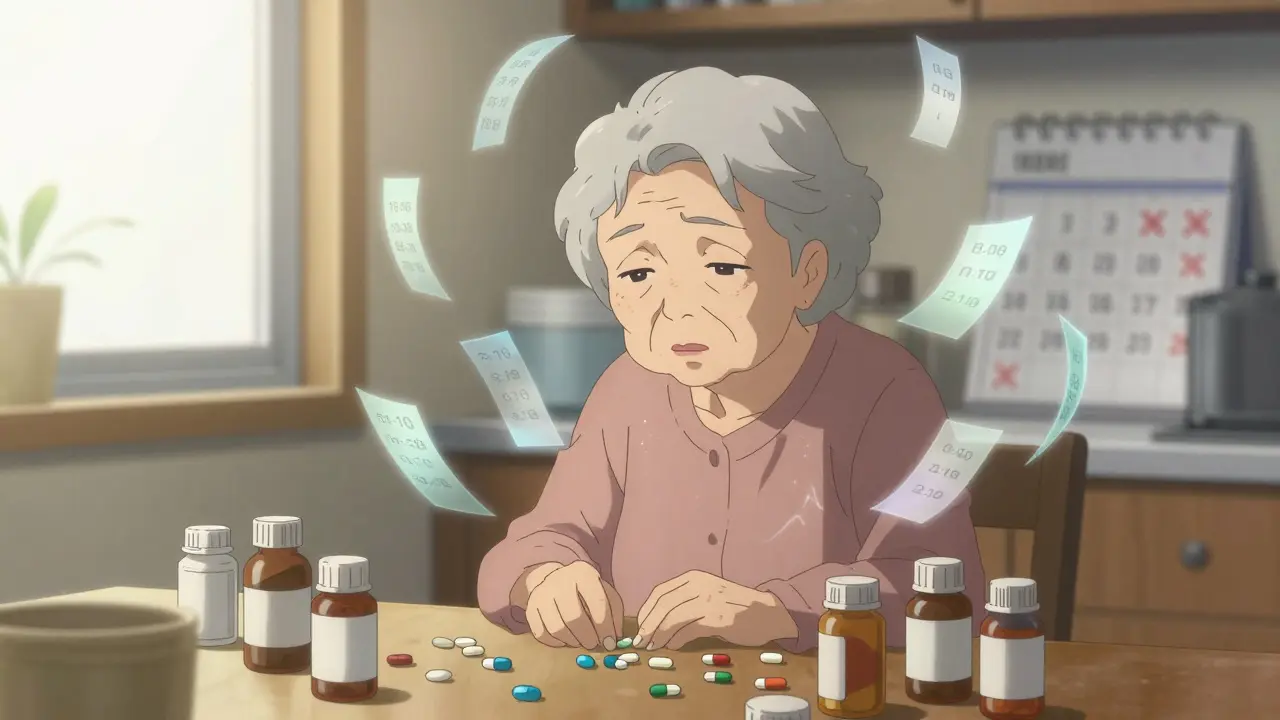
More than half of adults over 65 take five or more medications every day. Some take ten, fifteen, even twenty pills across multiple times of day-morning, noon, evening, bedtime. For many, it’s not just confusing; it’s overwhelming. Missed doses, double doses, pills left in the bottle-they’re not just mistakes. They lead to falls, hospital visits, and worse. The good news? You don’t need to keep this chaos going. Simplifying medication regimens for older adults isn’t just possible-it’s proven to work.
Why Complex Medication Regimens Are a Problem
It’s not about taking too many pills. It’s about how they’re scheduled. A typical regimen might include:
- One blood pressure pill at breakfast
- Another at bedtime
- Diabetes meds with each meal
- A cholesterol pill at night
- Thyroid medicine on an empty stomach
- Two different pain relievers, one for morning, one for evening
- A vitamin, a probiotic, and a sleep aid
That’s eight different times to remember. Add in pills that need to be taken two hours before or after food, with water only, or not with dairy-and it becomes impossible for someone with memory issues or arthritis to manage alone. Studies show that when older adults have five or more daily doses, adherence drops below 50%. That’s not laziness. It’s a system failure.
The goal isn’t to cut pills. It’s to cut complexity. Every time you reduce the number of times a person has to remember to take something, you improve safety. A 2020 study in Australian aged care homes found that simplifying dosing times alone improved medication adherence by 38% in residents who were previously struggling.
The Three Ways to Simplify Medication Regimens
There are three main strategies used by pharmacists and doctors to reduce burden without losing effectiveness:
- Fixed-dose combinations - Two or more drugs in one pill. For example, instead of taking a blood pressure pill and a diuretic separately, they’re combined into one tablet. This cuts two pills down to one, and two times a day down to one.
- Once-daily dosing - Switching from pills taken twice or three times daily to long-acting versions. Many blood pressure and diabetes medications now have once-daily forms that work just as well.
- Combining both - Using a combination pill that’s also once-daily. This is the gold standard when available.
These aren’t theoretical. In a 2020 U.S. trial of 1,500 older adults, 41% of medication regimens could be simplified just by switching to once-daily versions or combining pills. In Australia, pharmacists using the MRS GRACE tool successfully simplified regimens for 60% of residents in aged care homes.
What Medications Can Be Simplified?
Not all meds can be changed easily. Some need precise timing. But many can:
- Blood pressure meds: Many now come in once-daily forms. Switching from twice-daily to once-daily reduces errors by up to 50%.
- Diabetes meds: Metformin, GLP-1 agonists, and some sulfonylureas now have extended-release versions. Even insulin glargine can be given once daily instead of multiple injections.
- Cholesterol meds: Statins like atorvastatin and rosuvastatin are almost always once-daily. If someone’s on a twice-daily statin, it’s likely outdated.
- Antidepressants and antipsychotics: Many are available in once-daily or long-acting injectable forms, which cut daily pill burden dramatically.
- Pain relievers: If someone’s taking ibuprofen three times a day, switching to a once-daily extended-release version can help-unless they have kidney issues.
But here’s the catch: some meds shouldn’t be simplified. Thyroid hormone (levothyroxine) must be taken on an empty stomach, first thing in the morning. Statins work best at night. These timing rules matter. Simplification isn’t about ignoring science-it’s about finding smarter ways to follow it.

The Five-Step Simplification Process
Real simplification doesn’t happen in a 10-minute appointment. It takes planning. Here’s how it works:
- Get the full list - Write down every pill, patch, inhaler, and injection. Include over-the-counter drugs, vitamins, and herbal supplements. Many people forget these, but they add to the burden. Pharmacists call this the “best possible medication history.” It takes 30 to 60 minutes to do right.
- Check what’s still needed - Not every pill is necessary. Some were prescribed years ago and are no longer useful. Deprescribing-stopping meds that don’t help-is the first step in simplification. A 2021 Australian study found that 30% of older adults could safely stop at least one medication.
- Look for duplicates - Is someone taking two different blood pressure pills that do the same thing? Two painkillers with the same active ingredient? These are easy targets.
- Find combination options - Ask the pharmacist: “Is there a single pill that combines these two?” Many combinations exist for heart disease, diabetes, and high blood pressure.
- Match timing to life - Can a morning pill be moved to bedtime if it’s safe? Can a lunchtime pill be taken with dinner instead? Aligning doses with daily routines-like meals, TV time, or a nurse’s visit-makes adherence easier.
This isn’t something you do alone. It needs a pharmacist, a GP, and ideally, a family member or caregiver involved. The MRS GRACE tool, developed in Australia, gives clinicians a clear checklist to follow-and it’s now used in over 85% of Australian aged care facilities.
What Happens When You Simplify?
People don’t just take their meds more often. They feel better. One 78-year-old woman in Sydney stopped taking seven pills a day and now takes three. She used to forget her afternoon dose and end up dizzy. After switching to a once-daily blood pressure combo and dropping two unnecessary supplements, her dizziness disappeared. Her daughter said, “Mom actually remembers her pills now.”
Studies show:
- Adherence improves by 30-50% after simplification
- Medication errors drop by up to 30% in aged care homes
- Patients report feeling more in control of their health
- Family caregivers spend less time managing meds
But here’s the important part: better adherence doesn’t always mean better health outcomes. A 2020 review found that while people took their pills more often, their blood pressure or blood sugar didn’t always improve. Why? Because simplification only fixes one part of the puzzle. If someone’s diet is poor, or they’re not moving enough, pills alone won’t fix it. But if they’re taking their meds correctly, the rest becomes easier to manage.
Challenges and When to Be Careful
Simplification isn’t risk-free. Some things must stay the same:
- Thyroid meds must be taken on an empty stomach, at least 30 minutes before food.
- Statins work best at night because the liver makes cholesterol while you sleep.
- Some antibiotics or antivirals need strict timing to stay effective.
Also, not all doctors know how to simplify. A 2023 survey found only 40% of GPs routinely check if an older patient’s regimen is too complex. That’s why you need to ask. Say this: “Can we look at my meds and see if any can be combined or taken less often?”
Another barrier? Time. A full medication review takes 45 minutes. Most GP visits are 10. That’s why pharmacists are becoming key players. In Australia, Medicare now funds Medication Management Plans for older adults with complex needs. These are done by pharmacists in community pharmacies, not just hospitals.

How to Get Started
If you’re helping an older adult with too many meds:
- Collect every pill bottle, even the empty ones.
- Make a list: name, dose, time, reason.
- Call their pharmacist. Ask for a Medication Review. It’s free under Medicare for people over 75 or with chronic conditions.
- Ask: “Can any of these be combined? Can any be taken once a day instead of more?”
- Don’t stop or change anything without professional advice.
Many pharmacies now offer “medication tidy-up” services. They sort pills into blister packs, label them clearly, and flag any risks. Some even deliver them weekly. That’s not just convenience-it’s safety.
What’s Next for Medication Simplification
Technology is catching up. Electronic health records now include tools that flag complex regimens. Epic Systems, used in many clinics, has a built-in tool that scores how complicated a patient’s meds are and suggests simplifications. In Australia, the University of Sydney is running a major trial to see if using the MRS GRACE tool cuts hospital admissions in aged care.
But the real change isn’t in tech. It’s in mindset. We’ve spent decades thinking more pills = better care. The truth is, fewer, smarter doses = safer care. As the population ages, this won’t be optional. It’ll be essential.
For older adults, simplifying meds isn’t about cutting corners. It’s about reclaiming time, dignity, and peace of mind. One less pill to remember. One less worry. One more day living well.
Can I just stop a medication if it seems unnecessary?
No. Never stop a medication without talking to your doctor or pharmacist. Some drugs need to be tapered slowly to avoid withdrawal effects or rebound symptoms. Even if a pill seems unimportant, it may be preventing a serious issue. Always get professional advice before making changes.
Are combination pills as effective as taking separate ones?
Yes, if they’re made properly. Fixed-dose combinations are tested to ensure the same absorption and effect as taking the drugs separately. In fact, some studies show better results because people are more likely to take one pill than two. Always check with your pharmacist that the combination is appropriate for your specific health needs.
What if my loved one has memory problems?
Simplification becomes even more critical. Use blister packs, pill organizers with alarms, or automated dispensers. Many pharmacies offer pre-sorted weekly packs labeled with times of day. Pair this with a daily check-in from a family member or home care worker. The goal is to reduce the mental load-fewer choices, clearer labels, and consistent routines make a big difference.
Does Medicare cover medication reviews for seniors?
Yes. In Australia, Medicare funds a Medication Management Plan for people aged 75 and over, or those with chronic conditions taking multiple medications. This includes a comprehensive review by a pharmacist, who can recommend simplifications, deprescribing, or adjustments. Ask your GP for a referral.
How long does it take to see results after simplifying meds?
Adherence often improves within weeks-people start taking their meds more consistently as the routine becomes simpler. Physical improvements like lower blood pressure or better blood sugar control may take 4-8 weeks, depending on the medication. The biggest immediate benefit is fewer mistakes and less stress for both the person and their caregivers.
Next Steps
If you’re caring for someone with a complex regimen, start today. Gather all the bottles. Write down every medication, including vitamins. Call their pharmacist and ask for a Medication Review. Don’t wait for the next doctor’s appointment. This is urgent. Every day with a confusing pill schedule is a day where something could go wrong. Simplification isn’t a luxury-it’s a lifeline.





8 Comments
Rhiannon Bosse
January 28, 2026Okay but let’s be real-how many of these ‘simplifications’ are just Big Pharma’s way of charging us more for one pill that used to be two generics? 🤔 I’ve seen the same exact combo pill cost 3x more than buying the two separate ones at Walmart. And don’t even get me started on how they drop the old versions right when seniors get used to them. 😒
fiona vaz
January 28, 2026This is so important. My grandma was taking 17 pills a day-some twice, some three times. We worked with her pharmacist and got it down to 5. She sleeps better, doesn’t get dizzy anymore, and actually remembers to take them. It’s not about fewer pills-it’s about fewer *moments of stress*. One less thing to worry about before breakfast.
Colin Pierce
January 29, 2026As a pharmacy tech, I see this every day. People come in with shoeboxes full of pills, confused as hell. The biggest win? Switching from BID to QD meds. Like, switching from lisinopril 10mg BID to 20mg QD? Same effect, half the mental load. And if they’re on a twice-daily statin? That’s almost always outdated-atorvastatin or rosuvastatin once daily is the gold standard now. Just ask the pharmacist. They’ll thank you later.
SRI GUNTORO
January 31, 2026People these days just want everything to be easy. But medicine isn’t a grocery list. You can’t just ‘simplify’ science because someone doesn’t want to remember when to take their pills. What if they have kidney issues? What if the combo pill has a filler they’re allergic to? This trend is dangerous. Responsibility isn’t outdated-it’s essential.
Lexi Karuzis
January 31, 2026Wait… so you’re telling me that after 30 years of doctors prescribing 8 different pills at 4 different times… suddenly, it’s ‘too complicated’? Who’s really behind this? The pharmaceutical companies? The insurance companies? They don’t want you to take 15 pills-they want you to take ONE expensive pill they control. And now they’re calling it ‘simplification’? 😏 I’ve seen this script before. It’s always the same: ‘Trust us, we know better.’
Brittany Fiddes
February 2, 2026Oh, please. The Americans think they’ve invented the wheel with this ‘medication review’ nonsense. In the UK, we’ve been doing this since the 1980s with Community Pharmacist Medication Reviews. We don’t need a fancy app or a ‘MRS GRACE tool’-we just have pharmacists who actually know what they’re doing. And yes, we still have people taking 12 pills a day… but at least we don’t pretend it’s ‘empowering’ when it’s just lazy medicine.
John Rose
February 3, 2026I’ve seen firsthand how this works. My dad had hypertension, diabetes, and high cholesterol. He was on 11 doses a day. We worked with his GP and pharmacist-switched to two combo pills, dropped two unnecessary supplements, and moved his statin to bedtime. He went from forgetting 3 times a week to never missing a dose. The change wasn’t just medical-it was emotional. He said, ‘I feel like I’m not a patient anymore. I’m just me.’ That’s worth more than any lab result.
Mark Alan
February 4, 2026MY GRANDMA TOOK 23 PILLS A DAY. NOW SHE TAKES 4. SHE’S PLAYING WITH HER GRANDKIDS AGAIN. 🎉❤️ I CRIED WHEN SHE SAID ‘I FORGOT WHAT IT FELT LIKE TO JUST WAKE UP.’