
Imagine waking up with your lips swollen, your tongue feeling thick, or your throat tightening - no hives, no itching, no obvious reason. You’ve been taking your blood pressure pill for years. Nothing’s changed. But now, you can’t breathe right. This isn’t an allergy. It’s ACE inhibitor angioedema, and it’s more common than most doctors realize.
What Exactly Is ACE Inhibitor Angioedema?
ACE inhibitors are among the most prescribed drugs in the world. Medications like lisinopril, enalapril, and ramipril help lower blood pressure, protect kidneys in diabetics, and improve heart function after a heart attack. Over 65 million Americans take them every year. But for about 1 in 200 people, these drugs trigger a silent, dangerous reaction: swelling deep in the face, lips, tongue, throat, or even intestines. Unlike allergic reactions, this isn’t caused by histamine. It’s caused by bradykinin - a chemical your body normally breaks down. ACE inhibitors block the enzyme that clears bradykinin. When it builds up, blood vessels leak fluid into surrounding tissues. That’s the swelling. No itching. No rash. Just sudden, painless, and potentially life-threatening puffiness.Why This Reaction Is So Dangerous
The biggest risk? Airway closure. Swelling in the tongue or throat can block breathing within minutes. Emergency rooms see this often - and too many patients are misdiagnosed. Doctors reach for epinephrine, antihistamines, and steroids because those work for allergies. But they do nothing here. Giving them delays the real treatment: stopping the drug and protecting the airway. Studies show that up to 30% of all angioedema cases in emergency departments are caused by ACE inhibitors. And here’s the scary part: half of all cases happen within the first week of starting the drug. But 20% show up after five, ten, even fifteen years of safe use. One patient in Australia developed swelling after 12 years on lisinopril. No warning. No prior signs. Just one morning, her tongue felt heavy.Who’s at Highest Risk?
This isn’t random. Certain groups are far more likely to react:- African descent: 2 to 4 times higher risk than other groups. The reason? Genetic differences in how the body breaks down bradykinin.
- Women: Twice as likely as men to develop it.
- People on DPP-4 inhibitors: If you’re taking a diabetes drug like sitagliptin or linagliptin along with an ACE inhibitor, your risk jumps 4 to 5 times.
- Long-term users: Even if you’ve taken the drug for years without issue, the risk never fully disappears.

How to Tell It Apart From Other Swelling
Not all swelling is the same. Here’s how to spot the difference:| Feature | ACE Inhibitor Angioedema | Allergic Angioedema | Hereditary Angioedema (HAE) |
|---|---|---|---|
| Trigger | ACE inhibitor medication | Allergen (food, insect sting, etc.) | Genetic C1-inhibitor deficiency |
| Itching or hives? | No | Yes | No |
| Response to epinephrine | No effect | Yes | No effect |
| Response to antihistamines | No effect | Yes | No effect |
| Duration after stopping trigger | Days to months | Hours to 1 day | Days, recurring without trigger |
| Treatment | Stop drug, icatibant, airway support | Epinephrine, antihistamines, steroids | C1-inhibitor concentrate, ecallantide |
What to Do If You Suspect It
If you notice sudden swelling of your lips, tongue, throat, or face - especially if you’re on an ACE inhibitor - act fast:- Stop taking the ACE inhibitor immediately. Don’t wait for a doctor’s call. This is non-negotiable.
- Go to the ER. Swelling can worsen quickly. Don’t drive yourself if your tongue or throat is involved. Call an ambulance.
- Tell the staff you’re on an ACE inhibitor. Say: “I think this is ACE inhibitor angioedema.” Many ER doctors don’t recognize it. Be specific.
- Don’t accept antihistamines or steroids as the main treatment. They won’t help. Ask if they have icatibant (FIRAZYR) - it targets the root cause.
What Happens After the Episode?
Once the swelling starts to fade, the real work begins:- Never take an ACE inhibitor again. Even if you feel fine, restarting the drug can trigger a much worse reaction. This is a permanent contraindication.
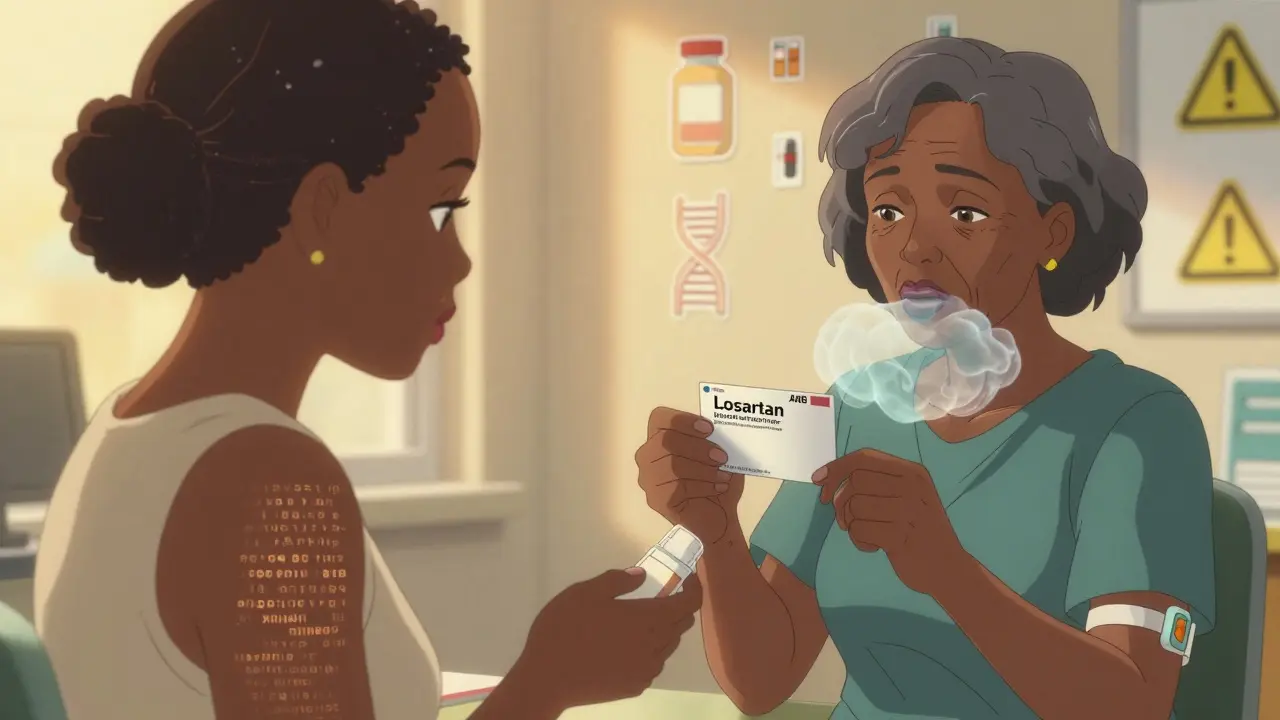
- Switch to an ARB. Drugs like losartan or valsartan work similarly to ACE inhibitors but don’t raise bradykinin. The risk of angioedema with ARBs is about 10 times lower.
- Watch for lingering swelling. Some patients report mild swelling for weeks or even months after stopping the drug. It’s not a relapse - it’s your body clearing out the leftover bradykinin.
- Get a medical alert bracelet. The American College of Emergency Physicians recommends this after a severe episode. It could save your life if you’re unconscious in an emergency.
- Make sure your medical records say “ACE inhibitor-induced angioedema” - not “allergy.” This distinction matters. Pharmacists and doctors might prescribe another ACE inhibitor if they think it’s just an “allergy.”
Why So Many Cases Are Missed
A 2022 survey found only 55% of emergency physicians correctly identified ACE inhibitor angioedema on first visit. Why? Because it looks like an allergy. Because patients don’t connect the dots. Because doctors assume it’s rare. One patient in Sydney had five ER visits over three months. Each time, she got antihistamines. Each time, the swelling came back. It wasn’t until she found a pharmacist who asked, “Are you on lisinopril?” that someone connected the dots. Studies show only 42% of patients who experience this reaction get proper counseling about avoiding ACE inhibitors forever. That’s unacceptable. This isn’t a side effect you can “try again later.”What’s Next? New Treatments and Prevention
The good news? Science is catching up. Icatibant, a drug that blocks bradykinin receptors, works in 2-4 hours and is now used in many major hospitals. Ecallantide and C1-inhibitor concentrate are alternatives, but they’re expensive - one dose of icatibant costs around $9,000 in the U.S. That’s why prevention is better than cure. Researchers are now testing genetic tests to identify high-risk patients before they even start an ACE inhibitor. The European Medicines Agency already recommends extra monitoring for people of African descent. In the next five years, experts predict genetic screening will become routine for those with family history or higher-risk backgrounds. Meanwhile, doctors are increasingly prescribing ARBs as first-line treatment for Black patients, women, and those with diabetes - not because they’re better for blood pressure, but because they’re safer.Bottom Line: Know the Signs, Act Fast
ACE inhibitor angioedema isn’t rare. It’s underrecognized. It doesn’t itch. It doesn’t respond to allergy meds. And it can kill you if you wait. If you’re on lisinopril, enalapril, ramipril, or any ACE inhibitor - and you notice swelling in your face, lips, or tongue - stop the drug. Go to the ER. Say the words: “I think this is ACE inhibitor angioedema.” And if you’ve had this happen before - never take one again. Your life depends on it.Can ACE inhibitor angioedema happen after years of taking the drug?
Yes. While half of cases occur within the first week, 20% develop after more than a year - and there are documented cases of swelling starting after 10 or even 15 years of safe use. This is why you can’t assume you’re safe just because you’ve taken the drug for a long time.
Are ARBs completely safe if I had ACE inhibitor angioedema?
Most people can switch safely - ARBs have about a 10 times lower risk of angioedema. But cross-reactivity happens in 10-15% of cases. If you’ve had a severe reaction, your doctor should monitor you closely when switching. Some patients develop mild swelling on ARBs too, so report any new swelling immediately.
Why don’t antihistamines or epinephrine work for this?
Because this isn’t an allergic reaction. Antihistamines block histamine, and epinephrine tightens blood vessels and reduces allergic inflammation - but ACE inhibitor angioedema is caused by bradykinin, a completely different chemical. These drugs have no effect on bradykinin buildup, so giving them wastes time and delays real treatment.
Is this condition hereditary?
No, ACE inhibitor-induced angioedema isn’t inherited. But your genetic makeup can make you more vulnerable. Certain gene variants - especially in the XPNPEP2 gene that controls bradykinin breakdown - increase your risk. This is why African descent and women are at higher risk. It’s not passed down like hereditary angioedema (HAE), but your genes still play a role.
How long does swelling last after stopping the drug?
Acute swelling usually improves within 24-48 hours after stopping the ACE inhibitor. But mild swelling, especially in the lips or tongue, can linger for weeks or even months as your body clears the excess bradykinin. This doesn’t mean you need to restart the drug - it’s just a slow recovery process.
Can I ever take an ACE inhibitor again if I had this reaction?
No. Once you’ve had ACE inhibitor-induced angioedema, you must avoid all ACE inhibitors permanently. Re-exposure carries a high risk of a more severe, potentially fatal reaction. This isn’t a warning - it’s a life-saving rule.
What should I tell my new doctor if I’ve had this reaction?
Say clearly: “I had ACE inhibitor-induced angioedema. I cannot take any ACE inhibitor - including lisinopril, enalapril, ramipril, or any other drug in this class.” Ask them to note it in your chart as a permanent contraindication, not just an “allergy.” Consider wearing a medical alert bracelet.
10 Comments
Carolyn Rose Meszaros
January 20, 2026I had this happen to me after 8 years on lisinopril. No hives, no warning. Just woke up with my tongue feeling like a balloon. ER thought it was an allergy. I had to beg them to stop the antihistamines. Took 3 days to fully go down. 🤯 Now I wear a medical alert bracelet. Don’t wait like I did.
Greg Robertson
January 21, 2026This is such an important post. I’m a pharmacist and I see this way too often. Patients come in with swollen lips and we give them Benadryl because that’s what’s in the protocol. No one thinks to ask about ACE inhibitors. It’s scary how common this is and how rarely it’s caught.
clifford hoang
January 23, 2026So let me get this straight… Big Pharma made a drug that causes your face to swell… and they’ve been pushing it for 30 years? 🤔 And now they want us to believe it’s just "genetics"? Nah. This is deliberate. They know ARBs are safer. They know bradykinin builds up. But why? Profit. Icatibant costs $9k? That’s not medicine. That’s a ransom note. Wake up, people. This isn’t science-it’s corporate control. 💀
Arlene Mathison
January 25, 2026I’m so glad someone finally wrote this. My mom had this after 11 years on ramipril. She thought she was having a stroke. Took her 3 ER visits before someone said, "Are you on blood pressure meds?" She’s fine now on losartan, but she’s terrified of any new pill. If you’re on an ACE inhibitor, stop scrolling and check your meds right now. Your life could depend on it. 💪
Emily Leigh
January 26, 2026Okay, but… why do we even still prescribe these? 🤷♀️ Like, we know 1 in 200 people get this. We know it can kill. We know ARBs exist. So why is lisinopril still the #1 go-to? Is it because it’s $4 a month? Come on. This isn’t a medical issue-it’s a financial one. And now they want us to pay $9k for the antidote? 😒
Renee Stringer
January 27, 2026I’m not saying this is a conspiracy, but… if you’re African American, female, and on a diabetes med too? You’re basically a walking time bomb. And no one tells you. Not your doctor. Not your pharmacist. Not even the pamphlet. You just… get lucky until you don’t. This is negligence. And it’s not okay.
Courtney Carra
January 28, 2026It’s fascinating how biology works. We block one enzyme to lower BP… and accidentally flood the system with a peptide that makes tissues swell like a sponge. It’s elegant, in a terrifying way. The body’s chemistry is so finely tuned… and we just poke it with a stick and wonder why it explodes. 🤯 We think we’re fixing things… but we’re just rearranging chaos.
Manoj Kumar Billigunta
January 29, 2026I am from India and we use lisinopril a lot here. Many doctors do not know about this side effect. I told my cousin who is on it to watch for swelling. She said, "But I feel fine." I said, "Feeling fine is not the point. Swelling is silent." She stopped it last week after noticing lip swelling. Now she is on valsartan. Safe is better than sorry.
Andy Thompson
January 31, 2026They’re lying. They know this happens. The FDA has known since the 90s. But they let it slide because the drug companies donate to their conferences. And now they want you to pay $9k for a fix? That’s not healthcare. That’s a racket. And they’re targeting Black people and women because they think we won’t fight back. Wake up. This is systemic. 🔥
sagar sanadi
February 1, 2026So… if I take ARBs now, and I get swelling again… does that mean the system is just swapping one poison for another? Or are we just playing whack-a-mole with our own biology? 🤨 I’m starting to think the real drug is trust. And we’ve been sold a fake one.